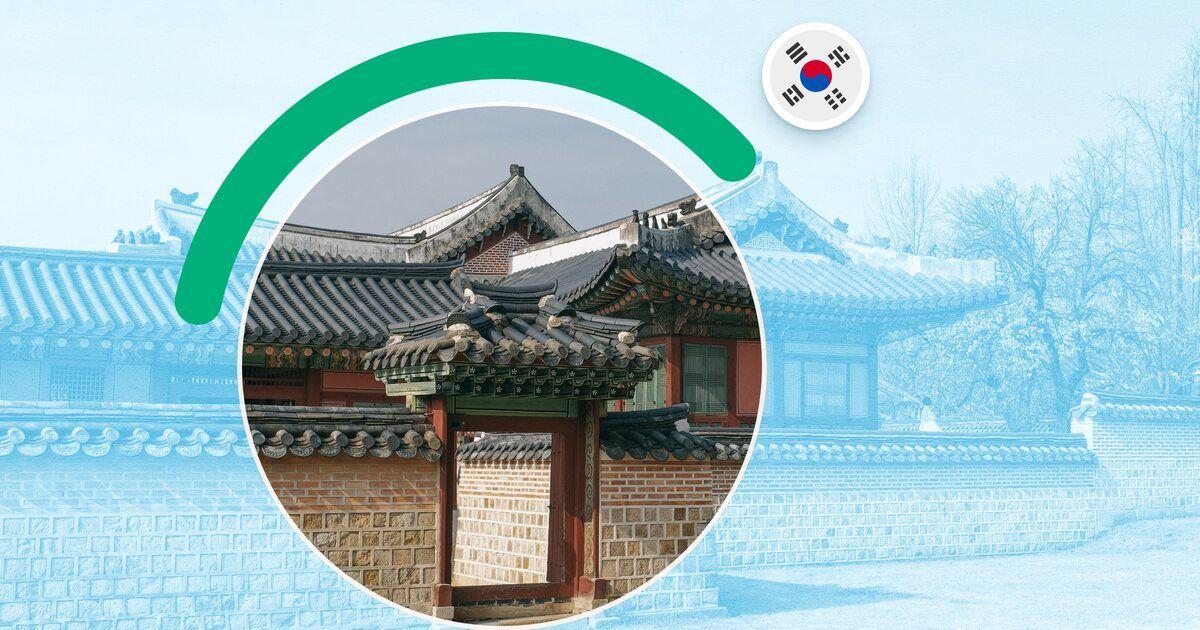
Tracing that culture through Seoul's markets today is easier with a HelloRoam South Korea eSIM. With data from the moment you land, Naver Map can guide you to the stalls and a translation app can read the menus.
Korean Street Foods to Order First, With Their Hangul Names
These ten dishes make a good first round. Match the Hangul to a stall's sign or menu; each description follows the Korean-English Learners' Dictionary of the National Institute of Korean Language.
 Get your Korea eSIM before you flyInstall it at home, then turn on data roaming for it when you land. From CA$4.88.See Korea plans
- Tteokbokki (떡볶이): sticks of garaetteok rice cake cooked with vegetables and seasonings such as soy sauce or gochujang, a red chili paste. At Tongin Market, try gireum tteokbokki, stir-fried in oil and seasoned either with soy sauce or with spicy red pepper flakes.
- Eomuk (어묵): fish cake made from mashed fish kneaded with salt and flour, also sold on skewers as eomuk kkochi (어묵 꼬치). Odeng (오뎅), a word taken from Japanese oden, means the same food.
- Gimbap (김밥): rice and other fillings rolled in dried laver seaweed, then sliced into bite-size pieces. Gwangjang Market is known for mayak gimbap, which VisitSeoul calls "addictive gimbap".
- Twigim (튀김): fish, meat or vegetables coated in flour and fried.
- Sundae (순대): pig's intestine stuffed with seasoned sweet potato noodles, tofu and glutinous rice, then steamed. VisitSeoul lists it among Gwangjang Market's favourite foods.
- Bindaetteok (빈대떡): a round, flat pancake of ground soaked mung beans with vegetables and meat, pan-fried. VisitSeoul lists it first among Gwangjang Market's favourite foods.
- Hotteok (호떡): a flat, round pancake of wheat or glutinous rice flour with a sweet filling such as sugar, pan-fried. The dictionary notes that it came to Korea from China.
- Bungeoppang (붕어빵): bread baked in a carp-shaped mould from thin flour batter, filled with red beans or cream.
- Gyeranppang (계란빵): egg bread, made by mixing eggs into flour batter and baking it in a small mould.
- Gun-goguma (군고구마): sweet potato baked over a fire. Gunbam (군밤) are chestnuts roasted the same way.
What Korean Street Food Is Called: Gilgeori Eumsik, Bunsik and Pojangmacha
In Korean, street food is gilgeori eumsik (길거리 음식), which the learner's dictionary defines as food sold for quick consumption on the street. Food made from flour is bunsik (분식), and a bunsikjip (분식집) is a snack bar that sells light meals such as gimbap, tteokbokki and instant noodles.
A pojangmacha (포장마차) is a covered cart bar: a cart with four posts and a plastic cover, selling simple snacks and alcoholic drinks. For a row of them, go to Chang-dong Pocha Street, a long-standing alley of red tent bars just outside Exit 1 of Chang-dong Station on Lines 1 and 4. VisitSeoul lists its bars as typically open from 5 pm to 2 am, closed on Sundays.
Seoul Street Food Markets, With Hours and Subway Exits
VisitSeoul, the city's official travel guide, points visitors to Gwangjang Market and Namdaemun Market for street food. The table adds three more stops, with the hours VisitSeoul lists. Hours vary by stall, so check each market's VisitSeoul page on the day you go.
| Market | Subway | Hours listed by VisitSeoul | What to try |
|---|---|---|---|
| Gwangjang Market | Jongno 5-ga Station (Line 1), Exit 8 | Food alley daily, 9 am to 11 pm | Bindaetteok, mayak gimbap, sundae, yukhoe (beef tartare) |
| Namdaemun Market | Hoehyeon Station (Line 4), Exit 5 for Kalguksu Alley | Monday to Saturday; hours vary by stall | Kalguksu: thick noodles in a savoury broth |
| Tongin Market | Gyeongbokgung Station (Line 3), Exit 2 | Market daily, 7 am to 9 pm (varies by store); Dosirak Café 11 am to 3 pm (4 pm at weekends), closed Mondays and the third Sunday | Gireum tteokbokki and a token lunchbox |
| Mangwon Market | Mangwon Station (Line 6), Exit 2 | Daily, 10 am to 9 pm (varies by store) | Dakgangjeong (chicken gangjeong), croquettes, tteokgalbi |
| Chang-dong Pocha Street | Chang-dong Station (Lines 1 and 4), Exit 1 | Typically 5 pm to 2 am, closed Sundays | Street food and drinks in red tent bars |
Gwangjang Market opened in the early 20th century in central Seoul. Its food alley is open every day of the year, from 9 am to 11 pm. The rest of the market keeps 9 am to 6 pm and closes on Sundays.
Tongin Market began in June 1941 as a market for Japanese residents during the Japanese occupation, and Korean street vendors took it over after the Korean War. Today it has more than 70 stores, most of them restaurants and grocery shops. At its Dosirak Café you buy tokens, then trade them at participating stalls to fill a lunchbox.
Namdaemun Market is the largest traditional market in Korea, with more than 10,000 stores around Namdaemun Gate. Its Kalguksu Alley, near Exit 5 of Hoehyeon Station, serves bowls of thick noodles with tofu, seaweed powder and sesame seeds.
Mangwon Market has run for over 40 years, and Mangwon Hangang Park is nearby, so VisitSeoul suggests taking market food to the park for a picnic.
What Street Food Costs and How to Pay in Seoul
Prices differ by stall, so use one official figure as a guide. In September 2026, a roll of gimbap cost 3,923 won on average at Seoul restaurants, according to the Korea Consumer Agency's Chamgagyeok price service. The Bank of Canada's daily rate on the day we checked put 1,000 won at about $1.06 CAD. At that rate, the roll works out to about $4.15 CAD.
Korean banknotes come in 1,000, 5,000, 10,000 and 50,000 won. ATMs that take international cards carry a "Global" sign or the logos of the banks whose cards they accept, and VisitSeoul advises against exchanging money at uncertified booths.
You do not need to tip at a stall. VisitSeoul says tipping is not a Korean custom and service staff do not expect it.
Staying Connected While Exploring Korean Street Food Markets
Free Wi-Fi is easy to find in Seoul. VisitSeoul counts nearly 10,000 free hot spots, and most hotels, cafés and restaurants offer Wi-Fi, though you may need to ask for the password. Between hot spots, mobile data keeps your map and translation app working in a busy market alley.
Roaming on your Canadian plan keeps your own number for data, calls and texts. Rogers, for example, lists a 7-day Asia Travel Pass at $55 for South Korea, and its Roam Like Home Daily rate there is $18 a day. Check your own carrier's rate before you go; our guide to how an eSIM compares with roaming sets out the trade-offs.
You can also buy a Korean prepaid SIM card at the airport. VisitSeoul lists prepaid SIM sales at the CU convenience stores in the arrivals hall at Incheon. The airport's own facility list also shows SK Telecom, KT and LG U+ roaming centres in Terminal 1, some of them open 24 hours.
A HelloRoam eSIM skips the counter: you install it at home, and the plan starts when your phone connects to a network in Korea. Your phone must be carrier-unlocked and support eSIM, so check that your phone supports eSIM before you buy. HelloRoam support answers 24/7 by email and WhatsApp.
When you land, choose the HelloRoam line for cellular data and turn on data roaming for that line. The steps to install an eSIM show where both settings are on iPhone and Android, and your Canadian number stays active for calls while you're away.
Maps, translation and photo uploads all use data, so check how much data your trip needs before you pick a plan. If Seoul is a stop on the way to Japan, our Toronto to Tokyo flight guide covers connections through Incheon.
We checked every hour, price and rule in this guide on 26 October 2026, on the VisitSeoul, Korea Consumer Agency, Bank of Canada, Rogers and Incheon Airport pages. Hours and prices change, so check those pages again before you travel.
Sources
- 떡볶이 tteokbokki, Korean-English Learners' Dictionary (National Institute of Korean Language)krdict.korean.go.kr
- 어묵 fish cake, Korean-English Learners' Dictionarykrdict.korean.go.kr
- 오뎅 odeng (from Japanese oden), Korean-English Learners' Dictionarykrdict.korean.go.kr
- 꼬치 skewer, Korean-English Learners' Dictionarykrdict.korean.go.kr
- 김밥 gimbap, Korean-English Learners' Dictionarykrdict.korean.go.kr
- 튀김 fried food, Korean-English Learners' Dictionarykrdict.korean.go.kr
- 순대 sundae, Korean-English Learners' Dictionarykrdict.korean.go.kr
- 빈대떡 bindaetteok, Korean-English Learners' Dictionarykrdict.korean.go.kr
- 호떡 hotteok, Korean-English Learners' Dictionarykrdict.korean.go.kr
- 붕어빵 bungeoppang, Korean-English Learners' Dictionarykrdict.korean.go.kr
- 계란빵 egg bread, Korean-English Learners' Dictionarykrdict.korean.go.kr
- 군고구마 baked sweet potato, Korean-English Learners' Dictionarykrdict.korean.go.kr
- 군밤 roasted chestnut, Korean-English Learners' Dictionarykrdict.korean.go.kr
- 길거리 음식 street food, Korean-English Learners' Dictionarykrdict.korean.go.kr
- 분식 flour-based food, Korean-English Learners' Dictionarykrdict.korean.go.kr
- 분식집 bunsikjip (snack bar), Korean-English Learners' Dictionarykrdict.korean.go.kr
- 포장마차 covered cart bar, Korean-English Learners' Dictionarykrdict.korean.go.kr
- VisitSeoul: About Seoulenglish.visitseoul.net
- VisitSeoul: Gwangjang Marketenglish.visitseoul.net
- VisitSeoul: Namdaemun Marketenglish.visitseoul.net
- VisitSeoul: Namdaemun Kalguksu Alleyenglish.visitseoul.net
- VisitSeoul: Tongin Marketenglish.visitseoul.net
- VisitSeoul: Gireum Tteok-bokki at Tongin Marketenglish.visitseoul.net
- VisitSeoul: Mangwon Marketenglish.visitseoul.net
- VisitSeoul: Chang-dong Pocha Streetenglish.visitseoul.net
- VisitSeoul: Money (currency, ATMs, tipping)english.visitseoul.net
- VisitSeoul: Phone & Internet (prepaid SIM, eSIM, Wi-Fi)english.visitseoul.net
- Korea Consumer Agency, Chamgagyeok: dining-out prices by region (September 2026)www.price.go.kr
- Bank of Canada: Daily exchange rateswww.bankofcanada.ca
- Rogers: U.S. and International Travel Roaming Optionswww.rogers.com
- Rogers: FAQs about Roam Like Home Travel Passes (destinations)www.rogers.com
- Incheon International Airport: Convenience and public facilitieswww.airport.kr
Written by
HelloRoam Team
The HelloRoam Team writes our guides on trip planning, visas and eSIMs. For every new or updated guide, we check each fact at its source. Sources include government, park and weather service pages. We note the date we read each one. A second review then checks every fact against its source before the guide goes live. If we cannot confirm a fact, we leave it out. We link those sources inside the guide, so you can check them.