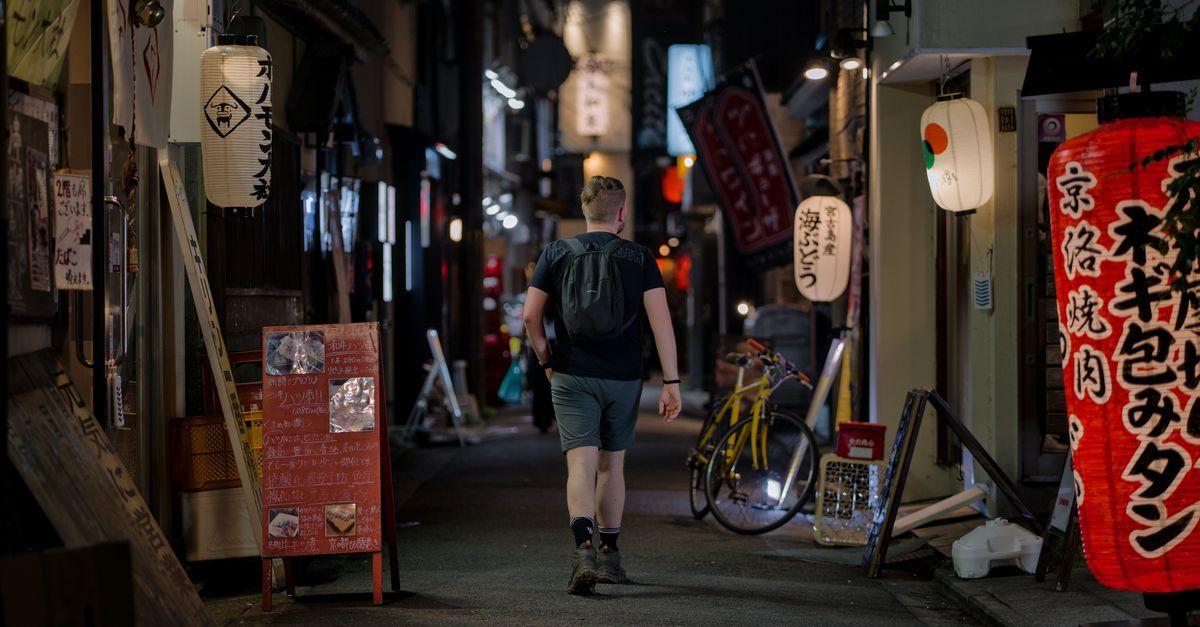
A HelloRoam Japan eSIM plan installs at home over Wi-Fi and starts when it first connects to a network in Japan, so maps and train times work from the arrivals hall.
We read every roaming rate below on Bell's, Rogers', Koodo's and Freedom's own roaming pages, and the networks behind our Japan plans in our catalogue, on November 6, 2026.
Your phone decides between a SIM card and an eSIM
Apple's list of SIM types settles it for iPhones. The iPhone 17, 17 Pro, 17 Pro Max, 17e, 18 Pro and 18 Pro Max bought in Canada work with eSIM only, and so do the iPhone Air and iPhone Duo. Canadian iPhone 16 models, the 16e included, and older models back to the iPhone XS and XR take one nano-SIM card plus an eSIM, except the iPhone SE (2nd generation), which Apple lists as nano-SIM only. Our guide to Canadian iPhones with no SIM tray adds model numbers and phones bought abroad.
 Get your Japan eSIM before you flyInstall it at home, then turn on data roaming for it when you land. From CA$4.47.See Japan plans
On a phone with one SIM tray, a Japanese SIM card takes the place of your Canadian card, so your Canadian number keeps working only if it lives on an eSIM. With an Android phone, check whether your phone supports eSIM and whether it has a SIM tray.
A SIM card or an eSIM from another company also needs an unlocked phone. Japan's national tourism organization (JNTO) says your phone must be unlocked to use a SIM card, and Apple says the same of a travel eSIM. On an iPhone, open Settings, tap General, then About: "No SIM Restrictions" next to Carrier Lock means it's unlocked. If it shows a lock, contact your carrier well before the trip: Apple says only your carrier can unlock an iPhone, and the request might take a few days.
Bring a phone that runs on 4G LTE or 5G. The 3G networks of au, SoftBank and NTT docomo have all closed, the last of them, docomo's FOMA, on March 31, 2026. Our checklist on whether your phone works in Japan covers the LTE bands to look for.
If your phone takes both a card and an eSIM, see how eSIM and SIM cards differ before you pick one.
Airports sell SIM cards and rent pocket Wi-Fi on arrival
JNTO's FAQ lists the usual routes: buy or rent a SIM card, eSIM or pocket Wi-Fi at the airport, or reserve one online and pick it up there. It calls eSIMs and pocket Wi-Fi especially convenient for short-term visitors. In the cities, JNTO points to the big electronics stores for SIM cards.
Each of the three main airports lists staffed counters and SIM card vending machines. Narita has machines in all three terminals, one of them before customs in Terminal 2. Haneda has counters in Terminal 3, its international terminal, and machines in Terminals 1 and 2. Kansai has machines on the first floor of both terminals, and one in Terminal 1 is open 24 hours, which helps after a late landing. Our guide to the flight from Toronto to Tokyo compares landing at Narita with landing at Haneda.
A pocket Wi-Fi router is a small hotspot you rent for the trip. Your phone, tablet or laptop joins it over Wi-Fi, so no phone needs a SIM change, which suits a group sharing one connection. JNTO says rental kiosks stand at all major airports, and you can also reserve a router online and have it delivered to your hotel.
A data-only SIM card or eSIM gives you no Japanese phone number. If you need one, look for a plan from a Japanese carrier that includes it: Apple notes that many local carrier plans for international travellers come with a local phone number.
Whatever you pick, keep a way to make calls. A data-only plan can't dial 110 for police or 119 for an ambulance or fire, the numbers on the Government of Canada's Japan page. Your Canadian line can stay on for that if your phone can call from Japan: docomo says its own customers whose phones lack VoLTE (calling over 4G) lost voice calls when its 3G network closed, so ask your carrier about your phone before you go. On Bell or Koodo, a call you make or answer, a text you send or data the line uses starts that day's roaming fee.
Roaming in Japan costs $16 to $18 a day on Bell, Rogers or Koodo
Roaming keeps your number and needs no new SIM. Bell lists Japan under Roam Better at $16 a day, charged only on days you make or answer a call, send a text or use data. Each day ends at 11:59 p.m. Eastern Time, Bell charges no more than 20 days per line in a billing period, and you use your plan's data, with speeds of up to 512 Kbps after 5 GB in a day. Bell's Asia Travel Passes cost $75 for 14 days or $90 for 30 days, and each one starts the moment you add it.
Rogers charges $18 a day for Roam Like Home in Japan, which uses your plan's data, talk and text, and you can text TRAVEL to 222 to confirm you're enrolled. Its Asia Travel Passes cost $30 for 3 days, $55 for 7 days, $70 for 14 days and $90 for 30 days.
Koodo's Easy Roam International costs $18 a day in Japan. It switches on for any day you make or answer a call, send a text or use data, and it uses your monthly plan's data. Koodo's Asia 14 Day Pass covers Japan for $70, and its Global 30 Day Pass covers it for $125.
Freedom charges no daily roaming fee. Japan is one of its 120+ Roam Beyond destinations, and Freedom says its monthly plans now include roaming in them, so check whether yours does. On a plan without it, a 30-day Roam Beyond pass adds Japan for $30 with 5 GB or $50 with 10 GB. These passes carry their own data, not your plan's, and once that data runs out, pay-per-use data in Japan costs $0.75 per MB. Freedom also says your phone needs VoLTE roaming for data, texts and calls in Japan, emergency calls included.
| Carrier | Daily option in Japan | Pass for 14 days | Pass for 30 days |
|---|---|---|---|
| Bell | $16 a day (Roam Better) | $75 (Asia Travel Pass) | $90 (Asia Travel Pass) |
| Rogers | $18 a day (Roam Like Home) | $70 (Asia Travel Pass) | $90 (Asia Travel Pass) |
| Koodo | $18 a day (Easy Roam International) | $70 (Asia 14 Day Pass) | $125 (Global 30 Day Pass) |
| Freedom | No daily fee | No 14-day pass listed | Included on plans with Roam Beyond, or $30 for 5 GB (Roam Beyond pass) |
If you use your phone every day, a pass costs far less over two weeks: 14 days at $18 comes to $252 on Rogers or Koodo against a $70 pass, and 14 days at $16 comes to $224 on Bell against $75. Bell's day rate and passes, Koodo's day rate and passes, and Rogers' Roam Like Home all draw on the data in your Canadian plan, so a small plan runs out in Japan just as it does at home.
Roaming does one thing a data-only plan can't: it keeps calls and texts on your Canadian number. Bell's Roam Better includes unlimited calls to Canada, and Koodo's Easy Roam International includes calls to Canada and to numbers in Japan, which suits a trip with a lot of calls home.
Telus and other carriers set their own Japan rates, so look Japan up on your carrier's travel page before you go. To see where a travel eSIM saves money and where it doesn't, compare an eSIM with roaming.
Our Japan plans run on NTT docomo, KDDI's au, SoftBank or Rakuten Mobile
HelloRoam sells travel eSIMs, so this part is about our own product, and our editorial policy on conflicts of interest explains how we handle that. Each Japan plan names the networks it can use. In our catalogue on November 6, 2026:
- The 1 GB 7-day plan and the 3, 5, 10 and 20 GB 30-day plans run on KDDI's au and SoftBank.
- The 50 GB 30-day plan runs on NTT docomo.
- The daily plan can use NTT docomo, KDDI's au, SoftBank or Rakuten Mobile.
Networks can change, so each plan page shows its current ones. KDDI, NTT docomo and SoftBank are also the three partners Bell lists for roaming in Japan.
The plans carry data only, with no Japanese number, calls or texts, so your Canadian line stays the one for those. You install the eSIM at home over Wi-Fi, and the plan starts when it first connects to a network in Japan. When you land, switch data roaming on for the new line, as our eSIM setup steps show. If it won't connect, there's 24/7 chat on WhatsApp and in the app.
With both lines on, Apple's travel eSIM guide says the travel eSIM carries your data, and your home line might still incur roaming fees. Supported iPhones keep two eSIMs active at once, and with iOS 26 or later the iPhone may ask on arrival whether to use the travel eSIM alone or both lines.
If Japan is one stop of several, our East Asia plans cover Japan, South Korea and mainland China on one eSIM, using KDDI's au in Japan. For a wider loop, our Asia plans use KDDI's au, NTT docomo or Rakuten Mobile in Japan. A Japanese voice plan still fits better if you need a local number, and pocket Wi-Fi if several people share one connection.
A week in Japan takes about 3.2 GB of data on light use
To estimate the data your trip needs, start from our calculator's casual traveller profile: 15 minutes each of photo feeds and short clips, an hour each of music and web browsing, and half an hour each of maps, messages and app updates a day. That comes to about 3.2 GB a week. Buy at least 3.9 GB, which adds 20% for busy days.
| Trip length | Light use (casual traveller) | Buy at least, with 20% for busy days |
|---|---|---|
| 7 days | 3.2 GB | 3.9 GB |
| 10 days | 4.6 GB | 5.5 GB |
| 14 days | 6.4 GB | 7.7 GB |
| 30 days | 14 GB | 17 GB |
Video moves the total most. The calculator counts HD video at about 1.4 GB an hour, so one hour a day adds about 9.8 GB a week, and its remote worker profile, with daily streaming and video meetings, reaches about 26 GB a week.
So two weeks of light use, at 7.7 GB with the margin, fits in a 10 GB plan with room to spare. On Bell, Koodo or Rogers' Roam Like Home, the same data comes out of your Canadian plan, and on Bell, speeds drop to up to 512 Kbps after 5 GB in a single day.
Wi-Fi covers some of it. JNTO says Japan's major international airports offer free Wi-Fi in their terminals and most major city hotels have Wi-Fi, though traditional ryokan and smaller minshuku may not.
The way to stay connected depends on your phone and your trip
| Your trip | What fits |
|---|---|
| Your iPhone is an Air, a Duo, or any iPhone 17 or 18 Pro model bought in Canada | A travel eSIM, roaming or pocket Wi-Fi, since no SIM card fits |
| Your phone has a SIM tray and you only need data | A Japanese data-only SIM card from the airport or an electronics store, or a travel eSIM |
| You want your Canadian number on and a week or more of data | A travel eSIM beside your Canadian line |
| You make a lot of calls home | Roaming on your Canadian plan, which includes calls to Canada |
| You need a Japanese phone number | A Japanese carrier's plan that includes a number |
| Two or more people want to share one connection | A pocket Wi-Fi rental |
| Japan is one stop on an East Asia trip | A regional eSIM plan |
Questions travellers ask
How do tourists get internet in Japan?
Visitors commonly buy or rent a SIM card, eSIM or pocket Wi-Fi at the airport, or reserve one online and pick it up there, as JNTO's FAQ says. Roaming on a Canadian plan is the other route, at $16 to $18 a day with Bell, Rogers or Koodo, and Japan's major international airports offer free Wi-Fi in their terminals.
Is 20GB of data enough for 2 weeks in Japan?
For light use, yes, with plenty to spare. Our data usage calculator puts two weeks of maps, messages, browsing, music, photo feeds, short clips and app updates at about 6.4 GB, so buy at least 7.7 GB with 20% added for busy days. Daily HD video and video calls change that: the calculator's remote worker profile reaches about 52 GB in two weeks.
How much does roaming cost in Japan?
As of November 6, 2026, Bell charges $16 a day in Japan, and Rogers and Koodo $18 a day. A 14-day Asia pass costs $70 at Rogers and Koodo and $75 at Bell, and Freedom, which lists Japan as a Roam Beyond destination, sells 30-day passes from $30 for 5 GB for plans that don't include it. Bell's and Koodo's options and Rogers' Roam Like Home use the data in your Canadian plan.
Sources
- Learn which type SIM your iPhone or iPad uses (Apple Support, Canada)support.apple.com
- How to unlock your iPhone for use with a different carrier (Apple Support, Canada)support.apple.com
- Wi-Fi in Japan (JNTO)www.japan.travel
- End of au 3G service CDMA 1X WIN, March 31, 2022 (KDDI, in Japanese)www.kddi.com
- 3G service ended July 31, 2024 (SoftBank, in Japanese)www.softbank.jp
- FOMA and i-mode service end, March 31, 2026 (NTT docomo, in Japanese)www.docomo.ne.jp
- Frequently asked questions: SIM card, eSIM or Wi-Fi in Japan (JNTO)www.japan.travel
- Cellular phone, Wi-Fi rental and SIM card sales locations (Narita International Airport)www.narita-airport.jp
- Cell phones, Wi-Fi rental and SIM (Haneda Airport)tokyo-haneda.com
- Wi-Fi rental and SIM (Kansai International Airport)www.kansai-airport.or.jp
- Japan travel advice and advisories (Government of Canada)travel.gc.ca
- Use eSIM while traveling internationally with your iPhone (Apple Support, Canada)support.apple.com
- Coverage map and travel options, Japan (Bell)www.bell.ca
- Roam Better FAQ (Bell)www.bell.ca
- Roaming, Travel Pass and Roam Like Home options (Rogers)www.rogers.com
- Easy Roam and Easy Roam Travel Passes (Koodo)www.koodomobile.com
- International roaming and Roam Beyond (Freedom Mobile)www.freedommobile.ca
Written by
HelloRoam Team
The HelloRoam Team writes our guides on trip planning, visas and eSIMs. For every new or updated guide, we check each fact at its source. Sources include government, park and weather service pages. We note the date we read each one. A second review then checks every fact against its source before the guide goes live. If we cannot confirm a fact, we leave it out. We link those sources inside the guide, so you can check them.