Want the quietest island instead? February had the fewest foreign arrivals of 2025 (450,697) and the fewest Australian visits (96,421), according to Statistics of Bali Province. The trade-off is rain: January, February and March are among the wettest months on BMKG's long-term record.
Rain or shine, a HelloRoam Bali eSIM keeps the BMKG forecast a tap away from the day you arrive, and its support team answers 24/7.
Rain, Not Heat, Separates Bali's Two Seasons
Bali has two seasons. Virgin Australia's guide puts the dry season from May to October and the wet season from November to April. Smartraveller says Indonesia's wet season usually runs from around October to April, and that heavy rain can flood parts of Bali and disrupt transport. Virgin Australia notes that wet-season showers usually pass quickly.
 Get your Indonesia eSIM before you flyInstall it at home, then turn on data roaming for it when you land. From A$4.95.See Indonesia plans
Rain is the big difference. BMKG's long-term averages for Denpasar, published by the World Meteorological Organization, give January 345 mm of rain over 27 rain days and August just 25 mm over 4. June, July, August and September each average under 60 mm, and the twelve months add up to about 1,730 mm.
Heat changes far less. On BMKG's long-term averages, daily highs run from 29.6°C in August to 34.4°C in April, and lows stay between 22.5°C and 24.8°C. BMKG's newer 1991 to 2020 normals for the Ngurah Rai airport station put the warmest daily mean in November (28.0°C) and the coolest in August (26.1°C). Humidity barely moves either, from 78.2% in August to 81.5% in April on the same normals, so expect sticky air in every month.
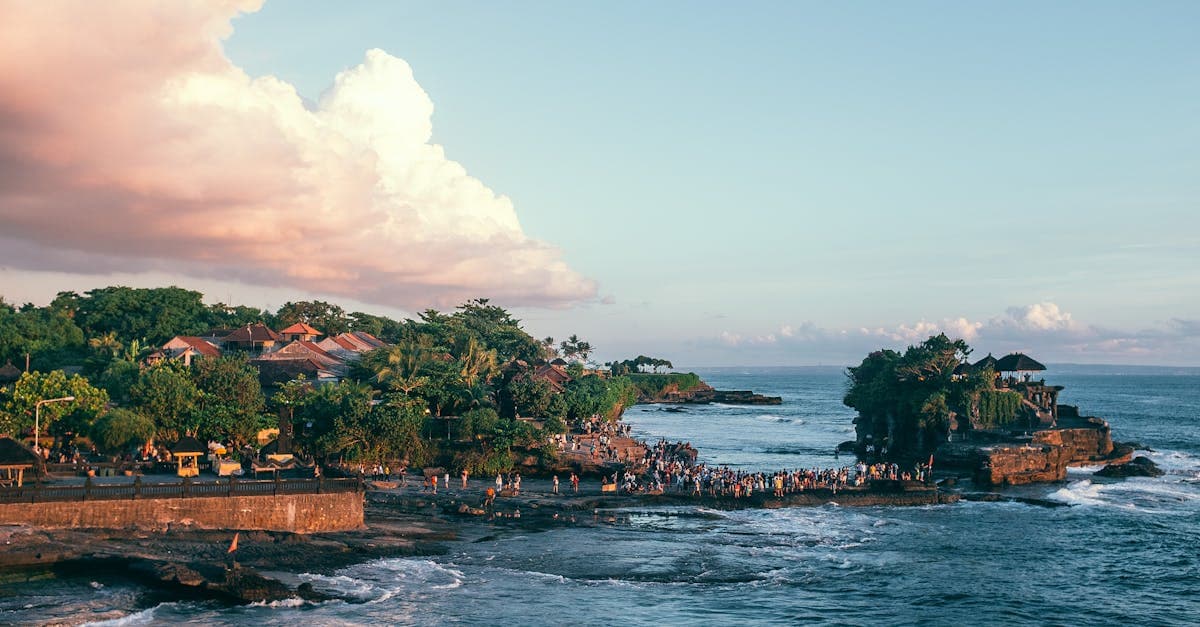
Daylight is steady too. The US Naval Observatory's tables put sunset in Denpasar between about 6.05 pm and 6.50 pm all year. A sunset at Uluwatu or Tanah Lot comes at much the same time whenever you go.
Monthly weather at a glance
| Month | Avg high (°C) | Avg low (°C) | Rainfall (mm) | Rain days |
|---|---|---|---|---|
| January | 33.0 | 24.1 | 345 | 27 |
| February | 33.4 | 24.2 | 274 | 22 |
| March | 33.6 | 24.0 | 234 | 20 |
| April | 34.4 | 24.8 | 88 | 9 |
| May | 33.1 | 24.1 | 93 | 8 |
| June | 31.4 | 23.5 | 53 | 6 |
| July | 30.4 | 23.0 | 55 | 4 |
| August | 29.6 | 22.5 | 25 | 4 |
| September | 31.4 | 22.9 | 47 | 8 |
| October | 33.6 | 23.7 | 63 | 12 |
| November | 32.7 | 23.5 | 179 | 16 |
| December | 33.0 | 23.5 | 276 | 22 |
These are BMKG's averages for Denpasar for 1961 to 1990, the record the World Meteorological Organization publishes for the city. Use them to plan, not as a forecast.
BMKG Expects the 2026 to 2027 Wet Season to Start Late
Heading over this summer? The rain may come later than usual. On 28 September 2026, BMKG's Bali climatology station said all 20 of Bali's season zones would start their wet season late, detik reported. Only 3 zones should turn wet in November 2026. The other 17, including Kuta, Denpasar and Ubud, should follow in December. RRI reported on 7 October that a very strong El Niño and a positive Indian Ocean Dipole are behind the delay.
The rain should peak in February 2027 in 16 of the 20 zones, and 18 zones should have a shorter wet season than normal. A BMKG observer warned that a shorter season can pack its rain into fewer weeks. That could mean heavier downpours around the February peak, NusaBali reported.
Seasonal forecasts shift, so check BMKG's forecast for Bali province on bmkg.go.id in the week before you fly.
Crowds Peak in July and Thin Out in February and March
Statistics of Bali Province counted 6,948,754 direct foreign arrivals in 2025. July was the busiest month with 697,107, and February the quietest with 450,697.
Australians shape that curve more than anyone. They made 1,628,459 visits in 2025, more than any other nationality and 23.44% of all foreign arrivals. Australian visits peaked at 161,051 in July, and Virgin Australia links Bali's July and August high season to Australia's winter and mid-year school holidays.
| Month (2025) | Foreign arrivals | Australian arrivals | Star hotel occupancy |
|---|---|---|---|
| January | 529,897 | 134,483 | 60.28% |
| February | 450,697 | 96,421 | 51.62% |
| March | 470,851 | 103,892 | 46.61% |
| April | 591,221 | 139,481 | 57.23% |
| May | 602,213 | 138,515 | 58.10% |
| June | 637,868 | 143,915 | 64.66% |
| July | 697,107 | 161,051 | 67.75% |
| August | 682,866 | 145,756 | 69.54% |
| September | 635,149 | 152,440 | 68.17% |
| October | 594,853 | 147,581 | 64.57% |
| November | 483,364 | 123,937 | 57.97% |
| December | 572,668 | 140,987 | 60.88% |
Source: Statistics of Bali Province, in the Bali Provincial Tourism Office's 2025 tourism statistics. Hotels follow the same curve: star-rated hotels were 69.54% full in August 2025 but only 46.61% full in March.
September and October are dry and a little calmer than July, but far from empty. September 2025 still drew 635,149 foreign arrivals and 152,440 Australian visits, more Australians than any month except July. If you're still choosing a base, see where to stay in Bali.
January to December: Rain and Visitors in Each Month
January to March. Expect plenty of rain: 345 mm in January, 274 mm in February and 234 mm in March on BMKG's averages. January 2025 stayed busy, with 134,483 Australian visits, while February and March were the quietest months of the year. Virgin Australia's guide says the wet season leaves the rice terraces lush and green. In 2027, March also brings Nyepi, the Day of Silence (see below).
April to June. Rain drops sharply, to 88 mm over 9 rain days in April, 93 mm in May and 53 mm in June. Visitor numbers climb with it, from 591,221 foreign arrivals in April 2025 to 637,868 in June. June gets about the same rain as July (53 mm against 55 mm) but had 59,239 fewer foreign arrivals in 2025.
July and August. These two months have the fewest rain days and the most visitors of the year. July averages 55 mm over 4 rain days and August 25 mm over 4, and they drew 697,107 and 682,866 foreign arrivals in 2025. Virgin Australia advises booking flights 6 weeks to 8 months ahead, and even earlier for July, August, December and January.
September and October. It stays dry, with 47 mm in September and 63 mm in October. October 2025 was a little quieter than September, with 594,853 foreign arrivals and 147,581 Australian visits.
November and December. Rain builds again, to 179 mm over 16 rain days in November and 276 mm over 22 in December. November 2025 had 483,364 foreign arrivals, one of the year's quietest months, and Virgin Australia lists November among the cheapest months to travel. December climbed to 572,668 arrivals, as Christmas and New Year bring Bali's second high season.
For plans that suit each season, our guide covers Bali's temples, rice terraces and day trips.
Families, Honeymooners and Surfers Suit Different Months
Virgin Australia's Bali guide breaks the year down by trip type:
- Families: July and August, in the school holidays, or May, June and September for families who can avoid the peak.
- Honeymoon: the dry season from May to October for weather, or any time outside July, August and December for better prices.
- Surfing: April to October for west-coast breaks such as Padang Padang, Echo Beach and Bingin, citing Bali's surf schools. The wet season suits east-coast breaks such as Nusa Dua, Serangan and Sanur.
- Diving and snorkelling: May to November for diving, when the water is calm and clear, and May to September for snorkelling. The sea stays at 26°C to 30°C all year, but strong currents and low visibility often make wet-season snorkelling hard.
- Hiking: May to September for clear views from Mount Batur and Mount Agung. Both are active volcanoes, and Smartraveller says to check MAGMA Indonesia's alerts before you trek.
Nyepi and Galungan Are the Holy Days to Plan Around
Nyepi, the Balinese Day of Silence, falls on Monday 8 March 2027, according to Indonesia's 2027 national holiday decree, published on 15 September 2026. For 24 hours, Balinese Hindus observe no work, no fire or light, no travel and no entertainment. Indonesia Travel asks visitors to stay indoors and keep lights and noise low, and hotels run with minimal staff. The night before, locals parade ogoh-ogoh effigies and then burn them.
The airport stops too. In 2026, Ngurah Rai suspended regular commercial flights from 6 am on 19 March to 6 am on 20 March. That stopped 440 flights, the airport's general manager told ANTARA.
Mobile data goes off as well. For Nyepi 2026, the communications ministry (Komdigi) asked operators to switch off mobile data and IPTV from 6 am to 6 am. Bali's provincial communications office said calls, SMS and Wi-Fi would stay on. A HelloRoam eSIM runs on Bali's local networks, so expect it to lose data for the day too. Download maps, shows and work files the day before, and check the 2027 arrangements with your airline and hotel.
Galungan is a celebration rather than a shutdown. It comes round every 210 days on the Balinese calendar, and Kuningan follows ten days later. In 2026 Galungan fell on 17 June and Kuningan on 27 June, RRI reported. The next Galungan falls 210 days later, on 13 January 2027, with Kuningan on 23 January. Expect penjor, tall bamboo poles hung with offerings, along the streets.
Temples are places of worship in Balinese Hinduism, not just sights. Indonesia Travel's temple guide says to cover your shoulders and knees, not to step on canang sari offerings and to follow temple officials. Sarongs and sashes are usually provided at the entrance.
Bali's Dengue Cases Have Clustered From January to May
Smartraveller says dengue occurs in Bali, and that Australian health authorities have reported dengue in people returning from Indonesia, including from Bali. A study of Bali's dengue cases from 2012 to 2017 found that most came from January to May. Its authors, Yudhastuti and Lusno (Jurnal Kesehatan Lingkungan Indonesia, 2020), linked them to the rainy season.
Smartraveller's advice is to use insect repellent and wear long, loose, light-coloured clothing and closed shoes. Take extra care in early mornings and late afternoons, when mosquitoes are most active. After heavy rain, avoid walking or swimming in floodwater, which can spread leptospirosis. Ask your doctor about health risks and vaccines before you go.
Smartraveller Advice and Entry Steps to Check Before Booking
As of October 2026, Smartraveller advises Australians to exercise a high degree of caution in Indonesia overall, Bali included, due to security risks. Higher levels apply only to the provinces of Papua Pegunungan and Papua Tengah. Besides the wet-season floods noted above, it says volcanic activity can delay or cancel flights. It also warns that Australians have died from methanol poisoning in Indonesia. For road, scooter and health risks, read our guide to staying safe in Bali.
Smartraveller lists two steps for a holiday. Complete the All Indonesia arrival card within 72 hours of travel, then apply for an e-VOA at least 48 hours ahead or buy a visa on arrival. Indonesia's Directorate General of Immigration charges IDR 500,000 for 30 days, and Smartraveller says the e-VOA adds a small online processing fee. You can extend once, to 60 days in total: online for an e-VOA, or at an immigration office for a visa bought on arrival. The Bali Provincial Government adds a tourist levy of IDR 150,000 per person, paid once per trip and separate from the visa. Your passport needs at least six months' validity from the date you arrive, and Smartraveller recommends six months from the day you leave too.
These rules change, so check Smartraveller, the immigration site and the Love Bali levy page before you go. Our guide to applying for the e-VOA walks through each step.
Flights, Fees and Average Spending Shape a Bali Budget
Virgin Australia names October, November, February and March as the cheapest months to visit, when lower demand brings better rates on rooms, tours and flights. Its direct flights take about 6 hours 30 minutes from Sydney, 6 hours 10 minutes from Melbourne and 6 hours 15 minutes from Brisbane. Our guide to budget flights from Sydney and Melbourne compares fares by city, and there's a separate guide to flights from Perth.
On the ground, the Bali Provincial Tourism Office's 2025 survey put average spending by foreign visitors at US$172.40 per person per day. That is about US$1,207 for a week before flights, or roughly A$1,740 at the Reserve Bank of Australia's rate on 16 October 2026. So A$1,000 a week means spending over 40% less than the average visitor.
Roaming adds up too. Telstra's International Day Pass for plan customers costs A$10 a day in Indonesia, with 2GB of data a day (Telstra, October 2026). A week of daily use costs A$70. Telstra charges it on any day you make or answer a call, send a text or use data, including background data. A text you receive won't start it. Before you choose, check Telstra's roaming page and compare roaming with a travel eSIM.
A Tourist SIM or eSIM Covers Mobile Data in Bali
Smartraveller says visitors staying less than 90 days can buy a tourist SIM card or eSIM to use Indonesia's mobile network. Stay longer with a phone bought overseas and you must register its IMEI with Indonesian Customs within the first 90 days. Reception and Wi-Fi are not always available in remote areas and on some resort islands, and Smartraveller advises against using public Wi-Fi for banking or personal information.
A HelloRoam Indonesia eSIM works across Indonesia, so a side trip to Lombok or the Gili Islands needs no second plan. Our guide shows how to install it on iPhone or Android while you're still at home. On a dual SIM iPhone, Apple says both numbers can make and receive calls and texts while one line carries mobile data. That way your Australian number can still get bank codes by SMS. Apple adds that the iPhone uses data from both lines only if you turn on Allow Mobile Data Switching. Leave it off to keep data on the eSIM.
Sources
- Denpasar climate averages, 1961 to 1990 (World Meteorological Organization, from BMKG)worldweather.wmo.int
- WMO climate normals 1991 to 2020, Stasiun Meteorologi I Gusti Ngurah Rai (BMKG data, NOAA NCEI archive)ncei.noaa.gov
- Sun and moon rise and set times, Denpasar (US Naval Observatory)aa.usno.navy.mil
- Awal Musim Hujan di Bali Mundur Dampak El Nino (RRI Denpasar, 7 October 2026)rri.co.id
- Prakiraan Cuaca Provinsi Bali (BMKG)bmkg.go.id
- Statistik Pariwisata Provinsi Bali 2025 (Bali Provincial Tourism Office; arrivals and hotel data from Statistics of Bali Province)cloud-ng.baliprov.go.id
- Best time to visit Bali (Virgin Australia)virginaustralia.com
- Flights to Bali: average flight times (Virgin Australia)virginaustralia.com
- SKB 3 Menteri: national holidays and collective leave 2027 (Ministry of State Secretariat, 15 September 2026)setneg.go.id
- How to spend Nyepi, the Day of Silence, in Bali (Indonesia Travel)indonesia.travel
- 24-hour operational suspension during Nyepi at Bali airport (ANTARA, 14 March 2026)bali.antaranews.com
- Pemerintah Imbau Provider Matikan Internet 24 Jam Saat Nyepi di Bali (Komdigi circular 2/2026)cnbcindonesia.com
- Akses Internet Via Wifi di Bali Dipastikan Tetap Normal saat Nyepi (Bali Diskominfos)metrotvnews.com
- Komdigi evaluasi operator yang nyalakan data saat Nyepi di Bali (ANTARA, 24 March 2026)antaranews.com
- Galungan 17 June and Kuningan 27 June 2026 (RRI, 17 June 2026)rri.co.id
- Galungan: penjor and the Balinese calendar (Love Bali, Bali Provincial Government)lovebali.baliprov.go.id
- Temples in Bali: etiquette and dress code (Indonesia Travel)indonesia.travel
- Indonesia travel advice (Smartraveller, updated 16 October 2026)smartraveller.gov.au
- Gambaran Kasus Demam Berdarah Dengue di Pulau Bali Tahun 2012-2017 (Yudhastuti and Lusno, JKLI, 2020)ejournal.undip.ac.id
- Visa B1: visa on arrival (Directorate General of Immigration)imigrasi.go.id
- Tourist levy FAQ (Love Bali, Bali Provincial Government)lovebali.baliprov.go.id
- International Roaming Day Pass (Telstra)telstra.com.au
- About Dual SIM with eSIM (Apple Support)support.apple.com
- Musim Hujan di Bali Mundur, Diprediksi Mulai November (detik Bali, 28 September 2026; Stasiun Klimatologi Bali press release)detik.com
- Durasi Musim Hujan Lebih Pendek, Bali Tengah Berpotensi Diguyur Hujan Ekstrem (NusaBali, 30 September 2026)nusabali.com
- Exchange rates (Reserve Bank of Australia, 16 October 2026)rba.gov.au
Written by
HelloRoam Team
The HelloRoam Team writes our guides on trip planning, visas and eSIMs. For every new or updated guide, we check each fact at its source. Sources include government, park and weather service pages. We note the date we read each one. A second review then checks every fact against its source before the guide goes live. If we cannot confirm a fact, we leave it out. We link those sources inside the guide, so you can check them.