Quick Answer: Winter in Japan for American Travelers
Here's how winter stacks up against peak season on the factors that actually determine trip cost:
 Get your Japan eSIM before you flyInstall it at home, turn it on when you land. From $3.20.See Japan plans
| Factor | Winter (Dec-Feb) | Peak Season |
|---|---|---|
| West Coast RT airfare | ~$600-$900 | ~$900-$1,400+ |
| Crowds at major sites | 30-50% fewer | Full volume |
| Tokyo temperatures | 36-54°F | 70-90°F+ |
| Sapporo temperatures | 12-30°F (~20 ft annual snow) | Mild, no snow |
| Ryokan rates | 20-40% below peak | Full pricing |
| Winter-only draws | Snow monkeys, powder, festivals | None |
Key fact: HelloRoam's eSIM for Japan starts at ~$3.49 for 1GB over 7 days on KDDI/au's 5G network. For a trip where navigation apps and real-time translation are constant companions, that's a lean cost of entry.
The details behind each row in that table are more layered than any snapshot can show.
Why Does Winter in Japan Appeal to American Travelers?
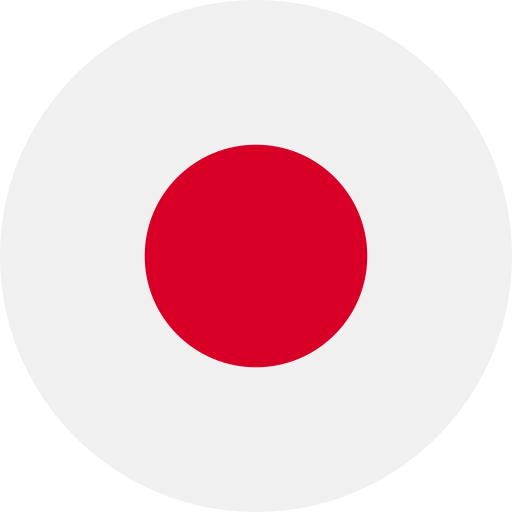
Japan recorded a record 36.8 million foreign visitors in 2024, and overtourism has become a real variable in American trip planning. Winter cuts through that problem with genuine data behind it.
The Fushimi Inari queue in Kyoto makes the argument better than any broad statistic: 45-60 minutes in autumn, under 10 minutes in January. Same vermilion torii gates, same hillside walk through cedar forest. The only difference is whether you're actually experiencing it or photographing the back of someone else's jacket.
The yen shifts the math entirely.
Through 2024 and 2025, the dollar held multi-decade strength against the yen, making Japan measurably more affordable for Americans than at any point in the previous decade. Ryokan rates already run 20-40% below their cherry blossom pricing. Add a favorable exchange rate on top of that, and everything on the ground (meals, local trains, sake, temple entry) comes in lighter than it looks on paper.
Mt. Fuji rewards the patience too. Winter air is drier and less hazy than summer, and the mountain stands statistically clearest December through February. Plenty of summer visitors pass within sight of the peak without ever seeing it clearly. Winter visitors rarely have that problem.
The skiing numbers are worth flagging for American readers. Lift tickets at major Japanese resorts run roughly ~$33-$53 per day. Comparable US destination resort tickets run $150-$200 or more. Niseko's annual snowpack averages 15 meters, with moisture content around 8%, well below the 10-15% typical at US resorts. The difference is tactile: lighter, drier, and the kind of conditions that make experienced skiers reconsider their home-mountain loyalty.
Lower prices are only part of the story. The winter calendar contains things that simply don't appear in spring.
Best Winter Experiences in Japan: Snow, Onsen, and Festivals
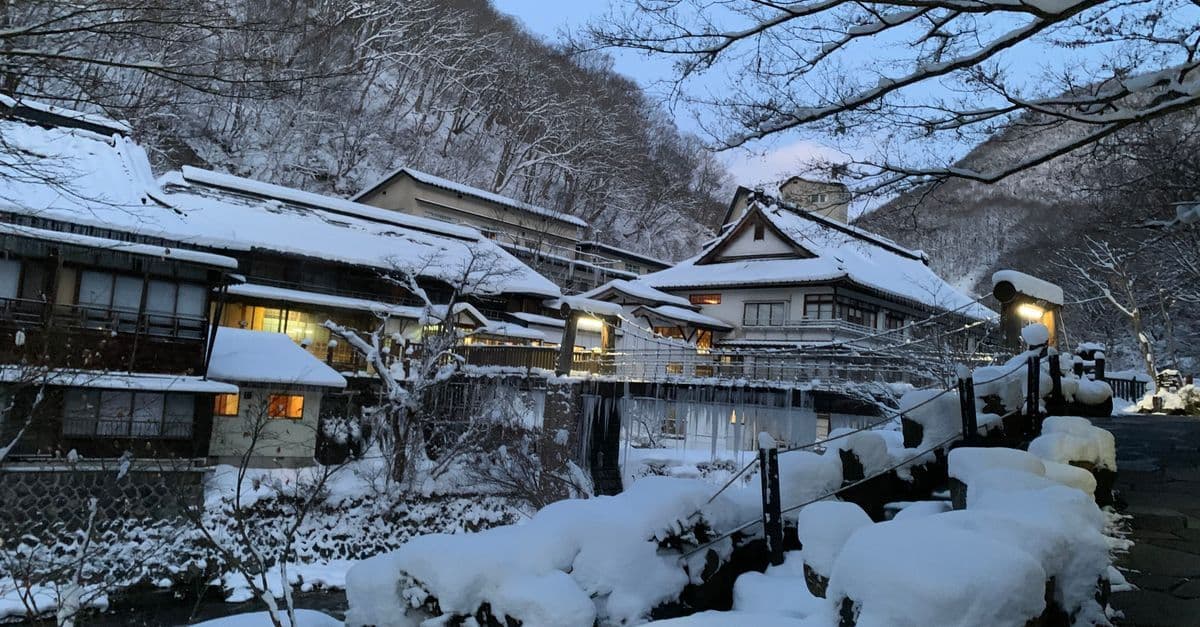
The most compelling winter experiences in Japan don't have a spring equivalent. They're not consolation prizes for missing cherry blossoms. They're the actual reason to come in December, January, or February.
A clean itinerary makes this concrete. Take a shinkansen north from Tokyo to Nagano, spend two nights at an onsen ryokan, catch Jigokudani Monkey Park on a January morning, then connect to Hokkaido for powder skiing at Niseko or Furano before flying home from New Chitose Airport. That route is impossible to replicate in April, and most of it is crowded off the table in autumn.
Three festivals worth building an itinerary around, in date order for 2026:
- Sapporo Snow Festival (Feb 4-11): giant snow and ice sculptures across Odori Park, roughly 2 million visitors over eight days
- Otaru Snow Light Path (Feb 6-15): hundreds of snow lanterns lining the canal district after dark, around 650,000 visitors, quieter and more atmospheric than Sapporo
- Nozawa Onsen Fire Festival (Jan 15): a torchlight ritual in a Nagano ski village drawing 10,000-15,000 people, with no US counterpart worth comparing it to
Plum blossoms open across central Japan in February, weeks before the cherry blossom crowds assemble. Koishikawa Korakuen in Tokyo and Kitano Tenmangu in Kyoto both hold plum festivals with almost no queue. Most Western visitors have never heard of them, which is the point.
The experience that surprises first-timers most, though, happens in a snow valley south of Nagano City.
Snow monkeys and drift ice: Japan's two wildest winter sights
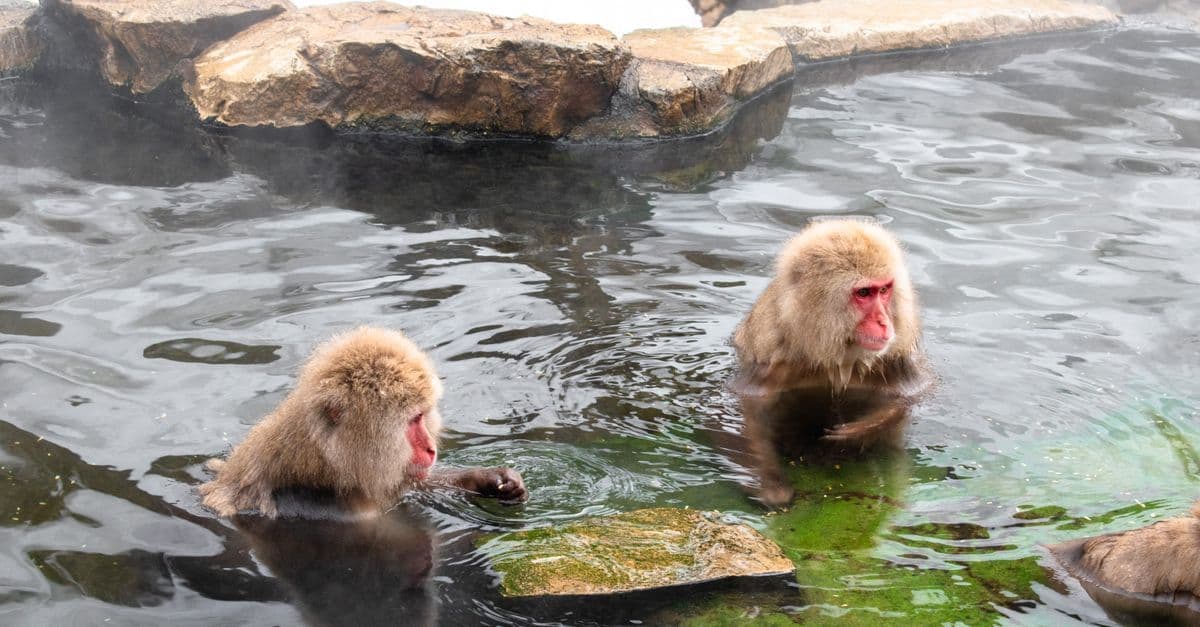
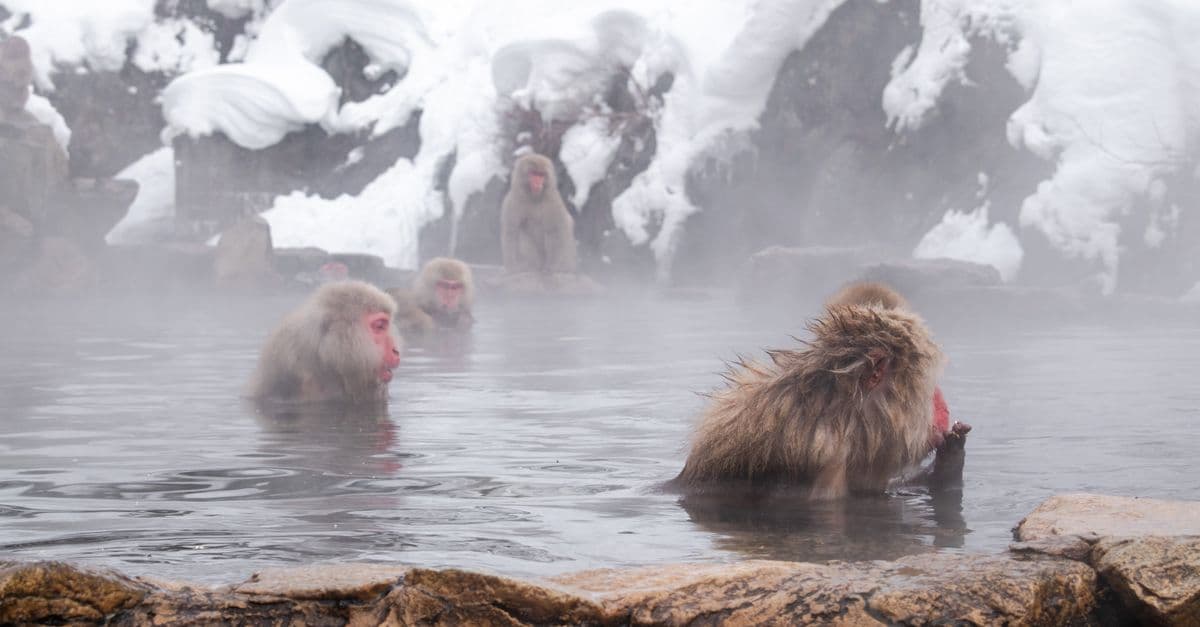
Jigokudani Monkey Park sits in a snow-covered valley near Yamanouchi in Nagano Prefecture, home to a troop of roughly 160 Japanese macaques. The hot spring bathing that made the park famous happens mainly in winter cold. They enter the 43°C (109°F) water willingly, and the logistics are dead-simple: a bus from Nagano Station to Kanbayashi Onsen, a 20-minute forest walk, and there they are. On a January morning you'll find macaques within arm's reach, completely indifferent to visitors.
No photograph fully prepares you for it.
Drift ice on the Sea of Okhotsk, accessible near Abashiri and the Shiretoko Peninsula in eastern Hokkaido, runs late January through mid-March. Guided walks let you move across floes in a dry suit, pack ice stretching to the horizon. This latitude, roughly 44°N, corresponds to Minneapolis or northern Oregon on the US map. Nowhere else at the same latitude on Earth produces drift ice; the enclosed geography of the Sea of Okhotsk creates conditions that simply don't occur at this parallel in North America or Europe. Eastern Hokkaido is, on this metric, a genuine anomaly.
The ski slopes deliver a different kind of reward, and for American travelers weighing a Hokkaido week against a comparable trip to Colorado or Utah, the price gap is hard to overlook.
Hokkaido skiing, Sapporo Snow Festival, and Tohoku ice traditions
Niseko averages 15 meters of snowfall per season. That figure sits at the top of any serious global skiing conversation, and when you pair it with champagne powder quality and lift ticket pricing of ~$33-$53 per day at Japanese resorts (compared with $150-$200 or more at US destination resorts), the case for Hokkaido becomes straightforward.
Sapporo's Snow Festival runs in early February each year; the 2026 edition ran February 4-11 and drew roughly 2 million visitors to Odori Park. Scale is the real attraction: ice sculptures spanning entire city blocks, many of them five or six stories tall. Teams from regional governments and international militaries compete for the best carve, and the result turns central Sapporo into something genuinely surreal for a few days each winter. Accommodation books out months in advance.
For a more considered experience, Yokote's Kamakura festival in Akita deserves attention. Held February 15-16 in 2026, the event draws around 70,000-80,000 visitors across two nights. Families build rounded snow igloos, place candles inside, and welcome strangers in for warm sake. It's quieter, distinctly local, and still largely off the foreign visitor circuit. The contrast with Sapporo's production-scale spectacle is striking.
Tohoku's winter traditions get overshadowed by Hokkaido in most travel coverage. That's the gap worth closing.
Which region fits your itinerary depends on the weather patterns you're prepared to navigate.
Japan Winter Weather by Region: Tokyo to Hokkaido
Japan doesn't have one winter. A mild, mostly snowless January in Osaka and a proper deep-winter January in Sapporo both exist within the same country, and the right choice depends entirely on what you're planning to do.
Tokyo sits in the 36-54°F range through December to February, but the feel on the ground tends to be crisper than those numbers imply. Relative humidity stays low across the winter months, stripping the heavy, damp weight from the cold. Americans calibrated to New York City or Chicago winters often find Tokyo in January less demanding than expected: dry air, frequent sun, and some of the clearest skies the city delivers all year.
Kyoto and Osaka run slightly warmer, both averaging 36-55°F through the winter months. Snow is rare in either city. Most winters bring only a light dusting, which is exactly why a snowy morning at Kinkaku-ji temple becomes a minor event worth catching when it actually happens.
Nikko, about 90 minutes north of Tokyo by train, behaves like a different country. The area receives around 150-200 centimeters of snowfall annually, and the UNESCO temples here get genuinely buried under it. For travelers wanting a day trip that feels far more wintery than the capital, Nikko delivers that without requiring a second accommodation booking.
Hakone, at elevation southwest of Tokyo, runs 30-50°F and picks up light snow at its higher points. The bigger draw is visibility: winter air tends to be drier, which means the Mount Fuji framing from Hakone in December or January is sharper and more reliable than anything available through summer haze.
Sapporo and Hokkaido belong in their own category: Sapporo averages 12-30°F through winter, with Niseko receiving 15 meters of seasonal snowfall on average.
The practical read: base in Tokyo for access and range, add Nikko for a committed snow day trip, and reserve Hokkaido for a dedicated push north. What you pack for each differs significantly.
Staying Connected in Japan in Winter: eSIM and Mobile Data
HelloRoam's Japan eSIM plans run on KDDI/au 5G and NTT Docomo 4G LTE networks, with a 5GB 30-day plan at ~$9.49 and a 10GB 30-day plan at ~$15.99, both activated remotely before departure. AT&T, T-Mobile, and Verizon all offer international day passes for Japan, but those per-day rates stack up fast across a longer itinerary. An eSIM sidesteps that entirely, and Japan is one of the cleaner arguments for setting one up before you fly.
Japan's mobile infrastructure is solid: 5G covers Tokyo, Osaka, Kyoto, and Sapporo's city centers. Nationwide 4G LTE (fourth-generation cellular data) fills the gaps, including major train corridors and most resort access routes. The network won't be the issue.
Getting set up:
- Purchase before departure. Buy the plan from home. On iPhone, the process works through iOS Settings; Apple Pay completes the transaction in one tap. Android users with Google Pay get the same friction-free flow. The eSIM profile installs in roughly 90 seconds.
- Keep your US line active alongside it. Your home number stays reachable for banking two-factor texts and any calls. The eSIM handles data.
- Arrive connected. Switch to the eSIM on landing. By the time you clear customs and pass the Global Entry kiosks, data is already running.
For a 10-day trip with active navigation, translation apps, and regular map use, the 5GB plan (~$9.49) fits most itineraries comfortably. Heavier users or anyone sharing a mobile hotspot should look at the 10GB option (~$15.99) instead.
Pocket Wi-Fi rental is the main alternative. It's clunky: airport counter pickup on arrival, counter return before departure, and a lost-device fee that adds low-level anxiety to every bag handoff.
eSIM for Japan before you board, and data is live the moment wheels touch down.
Is Winter a Good Time to Visit Japan?
For most American travelers, yes. The crowd-to-experience ratio in winter beats any other season across Honshu's main destinations.
The case is strongest for travelers combining cultural sightseeing with mountain time. West Coast flights run ~$600-$900 in winter versus ~$900-$1,400 or more at peak, and ryokan rates sit 20-40% below cherry blossom pricing. The ski economics make active weeks genuinely affordable by any US comparison. And the winter-exclusive experiences, including snow monkey onsen bathing at Jigokudani, drift ice walks at Abashiri, and outdoor hot springs in falling snow, simply aren't available at any price outside December through February.
The honest caveats are worth naming. Winter is the wrong season for beach travel. Okinawa and the Ryukyu Islands run warmer than Honshu, but cooler water temperatures, shorter days, and occasional overcast stretches push beach timing toward late spring or early autumn. Extended mountain hiking is also harder in winter: some trails close in December and January, and others require full cold-weather gear that most short-trip visitors don't pack.
December has a specific draw that most planning guides underestimate. Christmas illuminations run across Tokyo, Osaka, and Kyoto through December 25. They're layered and visually spectacular in a way no other season replicates, and crowds at these events stay well below the spring festival crush.
Most American travelers arrive primed for cherry blossoms or summer heat and leave having preferred the version of Japan they actually found. Getting the most from it starts with the right gear for whichever region you're heading into.
What Should I Pack for Winter in Japan?
Pack fewer items than you'd expect, but choose them more carefully. Three layers handle Tokyo and Kyoto: a moisture-wicking base, a mid-layer fleece, and a waterproof outer shell. Hokkaido demands five, adding thermal underlayers and a substantial insulating layer between the fleece and shell.
The biggest myth: you need a separate suitcase for winter gear. You don't.
Waterproof boots matter more than any other single item for Hokkaido and Tohoku travel. Snow compacts into ice on sidewalks, and regular sneakers become a liability by day two. Insulated, waterproof ankle boots with a grippy sole handle most urban and trail conditions. Crampons are overkill for city use.
Two items most Americans overpack: heavy wool overcoats and multiple scarves. Japan's convenience stores stock kairo (hand warmers) at every register. Grab a pack at FamilyMart or 7-Eleven on arrival and skip bringing the bulk from home.
Plug adapters aren't needed. Japan uses Type A outlets, the same flat two-prong standard as the US.
For transit, load a Suica or Pasmo IC (prepaid transit card) onto iPhone's Wallet app or Google Pay before you leave your hotel on day one. It works on trains, buses, and convenience store purchases across every major city.
Download Google Maps offline tiles for each region before you leave home. Signal across Japan is reliable, but offline tiles load instantly the moment you clear customs at Narita or Kansai International.
Questions travelers ask
Is winter a good time to visit Japan?
Yes. Winter offers 30-50% fewer crowds at major Honshu sites, West Coast round-trip flights around $600-$900 versus $900-$1,400+ at peak, and ryokan rates 20-40% below cherry blossom pricing.
How cold does Tokyo get in winter?
Tokyo ranges from 36-54°F December through February. The air is dry and frequently sunny, making winters feel less harsh than comparable temperatures in cities like New York or Chicago.
Is Japan crowded in winter?
No. Tourist numbers at major Honshu sites drop 30-50% from the autumn peak. Kyoto's Fushimi Inari queue drops from 45-60 minutes in autumn to under 10 minutes in January.
Sources
- GUIDEWinter in JapanCold weather and warm spiritsjapan.travel
- Winter in Japan: Your Seasonal Guideen.japantravel.com
- japan.traveljapan.travel

Written by
David Chen
David Chen is a travel writer at HelloRoam who covers mobile connectivity and travel tech for international visitors. He compares data plan pricing for short trips and extended stays, and tests eSIM activation at major international airports. David also covers hotspot options for business travelers so readers can skip the SIM card counter and get online fast.
 Mexico