Travel data, worked out
How Much Data Do I Need When I Travel?
On light use, a traveller needs about 3,2 GB of mobile data a week. That covers maps, messaging, browsing, music, photo feeds, short clips and app updates. Buy at least 3,9 GB for busy days. Daily video calls and streaming push a week to about 26 GB. Set your own hours in the HelloRoam Travel Data Calculator below.
HelloRoam Travel Data Calculator
Built by our team on the same hourly rates this page lists.

Quick travel data figures Based on the calculator's own rates
- Data for a light holiday week
- Around 3,2 GB so get 3,9 GB or more for busy days
- Data for a heavy week away
- Around 26 GB The Remote professional profile
- Each hour of HD video
- 1,4 GB Netflix's own figures depend on the quality setting.(1)
- Data for an hour of video calls between two people
- Around 520 MB on WhatsApp or FaceTime, against about 53 MB for a voice call
- Each hour of maps
- 10 MB Directions use little data next to video
- Data for an hour of scrolling short clips
- Around 600 MB watching TikTok, Reels or YouTube Shorts
- HelloRoam works across
- 185+ destinations, 212+ partner networks
How much data a trip takes, from three days to thirty
Light use stays small, with a long weekend at about 1,4 GB. Heavy use adds up quickly: daily video calls and streaming take a month to about 112 GB.

| Trip | Casual traveller (light use) | Buy this much or more (Casual traveller) | Remote professional (heavy use) | Buy this much or more (Remote professional) |
|---|---|---|---|---|
| Long weekend (3 days) | 1,4 GB | 1,7 GB | 11 GB | 14 GB |
| One week (7 days) | 3,2 GB | 3,9 GB | 26 GB | 32 GB |
| Two weeks (14 days) | 6,4 GB | 7,7 GB | 52 GB | 63 GB |
| One month (30 days) | 14 GB | 17 GB | 112 GB | 135 GB |
- Casual traveller, per day:
- 15 mins social photo feeds, 15 mins scrolling short clips, 1 hr music, 30 mins maps, 1 hr web browsing, 30 mins email and messaging apps, 30 mins app updates
- Remote professional, per day:
- 1 hr social photo feeds, 1 hr HD shows and videos, 2 hrs music, 30 mins maps, 1 hr web browsing, 1 hr email and messaging apps, 2 hrs group video meetings, 30 mins app updates
Is a 10GB data bundle enough for 2 weeks of travel?
Yes: a 10 GB data bundle covers two weeks of light use. A fortnight of maps, messaging, browsing, music, photo feeds, short clips and app updates comes to about 6,4 GB. With our 20% margin for busy days, buy 7,7 GB. Daily video calls and streaming push two weeks to about 52 GB, so take calls on Wi-Fi or pick an unlimited plan. Fair-use terms apply.
10 GB plan
Choose a plan that covers your total plus 20%, so one busy day does not leave you short. Once you have your number, compare data plans by destination.
A month of daily video calls and streaming runs past our largest fixed plan of 50 GB. Take calls on Wi-Fi where you can, or pick an unlimited plan. Fair-use terms apply. Away for longer? See our guide to long stays and remote work.
Data each travel app uses in an hour
Hourly data use runs from about 3,3 MB for messaging and email to about 1,4 GB for HD video. Each row is the calculator's planning rate for one hour of that activity.
| Activity | Data per hour | A week at 1 hour a day |
|---|---|---|
| Social photo feeds, , such as Facebook, Instagram | 110 MB | 770 MB |
| Scrolling short clips, , such as Reels, TikTok, YouTube Shorts | 600 MB | 4,2 GB |
| Video streaming (HD), , such as YouTube, Netflix, TikTok | 1,4 GB | 9,8 GB |
| Music streaming, , such as Spotify | 90 MB | 630 MB |
| Maps and directions, , such as Google Maps, Waze | 10 MB | 70 MB |
| Web browsing | 47 MB | 330 MB |
| Email and messaging apps, , such as WhatsApp, Gmail | 3,3 MB | 23 MB |
| Voice calls over data, , such as WhatsApp voice, FaceTime Audio | 53 MB | 370 MB |
| Video calls between two people, , such as WhatsApp video, FaceTime | 520 MB | 3,6 GB |
| Group video meetings, , such as Google Meet, Zoom | 930 MB | 6,5 GB |
| App downloads and updates | 270 MB | 1,9 GB |
These are planning rates, not exact meters. Your settings change the real number: the video row assumes HD, and the video call rows assume the camera stays on.
Here is how we turn an app's speed into data: one megabit per second for an hour is 450 MB, because a byte is eight bits.(8) A call counts what you send and what you receive.
TikTok, Reels and Shorts take about 600 MB an hour
StarHub, a network in Singapore, puts TikTok at about 840 MB an hour on default settings and about 360 MB in Data Saver mode.(7) The calculator counts 600 MB an hour, between the two. Switch on the app's data saver before you scroll on mobile data.(7)
Instagram and Facebook feeds take about 110 MB an hour
Photos cost far less data than video. StarHub, a Singapore network, puts an Instagram photo feed at about 120 MB an hour, and a mix of Stories and Reels at about 600 MB an hour.(7) The calculator counts 110 MB an hour for photo feeds, so count Reels time as short clips.
YouTube in HD takes about 1,4 GB an hour
Google recommends 1.1 Mbps for 480p video, 2.5 Mbps for 720p and 5 Mbps for 1080p.(4) At those speeds, an hour comes to about 500 MB, 1.1 GB and 2.3 GB. The calculator's HD row counts 1,4 GB an hour, between 720p and 1080p, so on mobile data choose 480p and use about a third as much.
Netflix can take 3 GB an hour in HD, or about 250 MB on Automatic
Netflix lists Low at up to 300 MB an hour, Medium at up to 700 MB and High at up to 3 GB in high definition.(1) On a phone, its Automatic setting gives about 4 hours per GB, roughly 250 MB an hour.(1) The calculator's HD row counts 1,4 GB, so lower the setting to stretch a small data bundle.
Google Maps directions take about 10 MB an hour
StarHub, a Singapore network, puts Google Maps navigation at about 5 MB an hour and Satellite View at about 150 MB an hour.(7) Directions on their own stay small, so keep Satellite View off on mobile data.
Budget about 520 MB an hour for a WhatsApp or FaceTime video call
StarHub in Singapore puts a WhatsApp video call between two people at about 250 MB an hour.(7) Zoom lists 600 kbps each way for a high-quality call between two people, about 540 MB an hour.(6) The calculator counts 53 MB an hour for a voice call in an app. Switch the camera off and a call uses about a tenth of the data.
Group calls on Zoom or Google Meet need about 930 MB an hour
A group call sends your video out and pulls everyone else's in. Zoom lists 1.0 Mbps up and 600 kbps down for high-quality group video.(6) For small teams and individuals, Google lists a Meet group meeting at up to 4.0 Mbps down.(3) The calculator counts 930 MB an hour, so join long meetings on Wi-Fi where you can.
Spotify music needs about 90 MB an hour here
Spotify streams at about 96 kbit/s on Normal, 160 kbit/s on High and 320 kbit/s on its highest setting.(5) An hour at those rates comes to about 43 MB, 72 MB and 144 MB. The calculator counts 90 MB, so set mobile streaming to Normal and download playlists on Wi-Fi before you leave.
How long each data bundle size lasts on a trip
At light use, 5 GB lasts about 10 days and 10 GB about 21 days. That means a 5 GB plan covers a light week with 20% or more to spare. HD video gets through 1 GB in about 45 minutes, and maps in about 100 hours.
| Data size | Days it lasts on light use | Maps | Social photo feeds | Scrolling short clips | HD shows and videos | Video calls between two people |
|---|---|---|---|---|---|---|
| 1 GB | 2 | 100 hrs | 9 hrs | 1 hr 45 mins | 45 mins | 2 hrs |
| 3 GB | 6 | 300 hrs | 27 hrs 15 mins | 5 hrs | 2 hrs 15 mins | 5 hrs 45 mins |
| 5 GB | 10 | 500 hrs | 45 hrs 30 mins | 8 hrs 15 mins | 3 hrs 30 mins | 9 hrs 30 mins |
| 10 GB | 21 | 1 000 hrs | 91 hrs | 16 hrs 45 mins | 7 hrs 15 mins | 19 hrs 15 mins |
Our fixed plans come in 1 GB for 7 days and 3, 5, 10 and 20 GB for 30 days in most destinations. Go for the smallest size that covers your estimate plus 20%.
Video streaming and video calls burn through the most data
What uses the most data when you travel?
Video uses your data fastest: an hour of HD streaming takes about 1,4 GB. A group video call uses about 930 MB an hour, short clips about 600 MB and a video call between two people about 520 MB. Maps need about 10 MB an hour. A whole light day of maps, messaging, music, browsing, photo feeds, short clips and app updates comes to about 0,46 GB.
Download map areas before you leave home
On Wi-Fi at home, save map areas in Google Maps for each place you will visit. With no connection, a saved map still gives driving directions inside that area, but not walking, cycling or transit routes.(9) Google says offline maps can't be downloaded in some countries or regions.(9) For walking, cycling or transit routes, or where downloads aren't possible, set your hours for maps in the calculator.
Lower the video quality in streaming apps
In the Netflix app, tap My Netflix, then your profile name, then App Settings, and open Cellular Data Usage under Video Playback.(1) Save Data gives about 6 hours per GB, while Maximum Data can use 1 GB every 20 minutes or more.(1) Netflix's data settings guide has the details.
Turn on your phone's data-saving setting
With Dual SIM, an iPhone can run Low Data Mode on the travel line alone, pausing its background tasks.(10) A Pixel's Data Saver keeps most apps' background data to Wi-Fi.(11) On a Samsung Galaxy, you'll find Data saver under Settings > Connections > Data usage.(12)
Hold app updates and photo backups until Wi-Fi
Set app updates and photo backups to Wi-Fi only before you leave home. The Casual traveller profile still counts some app updates each day, at about 270 MB an hour, so this one change can bring your real use under the estimate.



A smaller total lets you buy a smaller plan. Our prepaid travel eSIM guide covers more ways to spend less on trip data.
Track and cap your mobile data on iPhone and Android
Your phone logs the mobile data each app uses, so look at a normal month at home before you size your trip. A travel eSIM is a separate data line, and your phone sends mobile data over one line at a time.(13)(14) Your network keeps the most accurate count, so ask it for the exact figure.(15)(16) Read how a travel data line works, or see what the same data costs on roaming.

See your usage on iPhone
Go to Settings > Mobile Service and tap Show All to see the data each app used.(16) Take a recent month, divide it by 30, and compare that day with your trip estimate. To use less, switch off mobile data for apps you won't need on the trip.(16) Keep Allow Mobile Data Switching off, or the iPhone can use data from both plans.(13)
Checking on Android: Pixel and Samsung Galaxy
On a Pixel, go to Settings > Network & internet > SIMs and tap App data usage, then pick a time period.(15) Data warning & limit on the same screen can alert you, or switch mobile data off at the amount you set.(15) On a Samsung Galaxy, open Settings > Connections > Data usage > Mobile data usage, then tap the gear icon to set a data warning or limit.(12) With two SIMs, check that mobile data runs on the travel line.(14)
Checking your data in our app
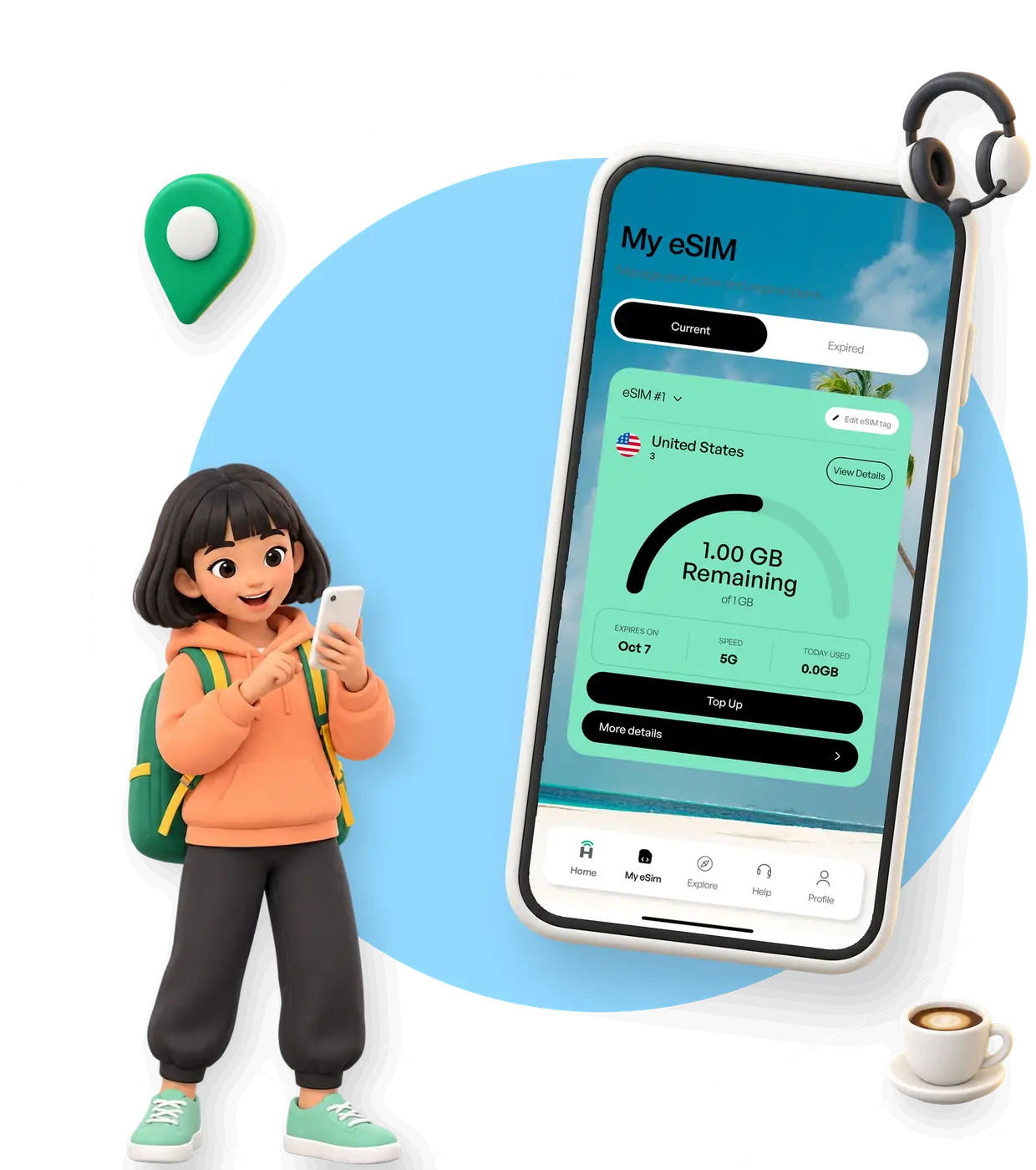
Open My eSIM in our app. Each eSIM's card shows the data left, or Unlimited on an unlimited plan, plus its Expires on date. The network reports use with a delay, so the figure can lag by up to 3 hours. On a fixed plan, we email you when your data runs low. Running short? Tap Top up on the card, where your plan allows it.
Hours of use times hourly rates give each estimate

How do I work out how much data I use?
Multiply each app's hourly rate by your hours a day, then add up your apps. The calculator above runs that sum for you and gives the total for your whole trip. Then add 20% for busy days and round up: that is the plan size to buy.
This data usage calculator multiplies each app's hourly rate by your hours a day. It adds up the apps for a daily total, then multiplies that by your trip days.
| Activity | Time per day | Data used |
|---|---|---|
| Maps | 2 hrs | 20 MB |
| Social photo feeds | 1 hr | 110 MB |
| Group video meetings | 30 mins | 470 MB |
| Total | 3 hrs 30 mins | 0,6 GB a day |
That half-hour video call uses more data than two hours of maps and an hour of photo feeds put together.
Start with a profile or your own hours
Start from Casual traveller or Remote professional, or set your own hours for each activity.
Hours become megabytes
Each hour of an activity adds its hourly rate in MB, and totals switch to GB at 1 000 MB.
Multiply one day by your days
Add up a day's activities, then multiply by the number of days your trip lasts.
Add a margin for busy days, then pick a plan
Add 20% to your total for busy days, then round up, and pick a plan with at least that much data. HelloRoam plans support hotspot use on phones that allow it. A laptop or tablet on your hotspot uses the same plan.(17)(18)



Data terms in everyday words
You will meet these terms in phone settings, app menus and on this page.
- GB (Gigabyte)
- The size unit for most of our data plans. This guide counts 1 GB as 1 000 MB.
- Mbps (Megabits per second)
- Measures speed, not how much data you use.(19) Eight megabits make one megabyte.(8) Size a plan in GB, not Mbps.
- HD video (High definition)
- Sharper video that uses more data an hour than standard quality.(1)
- Low Data Mode (iPhone setting)
- Pauses background tasks to save mobile data, and with Dual SIM you can set it for one line only.(10)
- Data Saver (Android setting)
- A Pixel setting that keeps most apps' background data on Wi-Fi, so they use mobile data only while open.(11)
- Offline maps (Saved map areas)
- Map areas saved to your phone before the trip. Offline, they still give driving directions inside the saved area.(9)
- Background data (Data used out of sight)
- Data that apps use in the background, such as updates, photo backups and sync.(10)
Straight answers on travel data

How much data is normal to use per day while travelling?
About 0,46 GB a day covers light use on the Casual traveller profile: maps, messaging, browsing, music, photo feeds, short clips and app updates. Over a week, buy at least 3,9 GB. A Remote professional day of group video calls, streaming, music and lighter apps uses about 3,7 GB. For anything in between, set your own hours above.
How big a data bundle do I need for a month overseas?
A light month adds up to about 14 GB, so buy at least 17 GB. That covers maps, messaging, browsing, photo feeds, short clips, music and app updates. Daily video calls and streaming take about 112 GB a month, more than our largest fixed plan of 50 GB. Take calls on Wi-Fi, or pick an unlimited plan. Fair-use terms apply.
What data do I need to run my job from overseas?
Plan on about 26 GB a week for remote work on your phone, or 32 GB with our 20% margin for busy days. That is the Remote professional profile: two hours of group video calls, an hour of video and two hours of music a day, plus lighter apps. A laptop on your hotspot adds its own use on top.(18)
How many days does 1 GB of data last on holiday?
On light travel use, 1 GB lasts about 2 days in this calculator. Used for one thing only, 1 GB gives about 100 hours of maps, 1,75 hours of short clips or 45 minutes of HD video. On Netflix's Automatic phone setting, you get about 4 hours of video per GB.(1)
Check your phone, then install before you fly
Once you know your total, these guides take you from checking your phone to getting online.

Where our figures come from
We cite help pages from Netflix, Google, Apple, Spotify, Zoom and Samsung, a Singapore network's app guide, the FCC and NIST, never other travel eSIM sellers.

We checked sources 1 to 5 and 7 to 18 on , and source 19 on , and source 6 on .
- 1
Netflix Help Center: How to control how much data Netflix uses
- 2
Apple Support: Set up eSIM on iPhone
- 3
Google Workspace Help: Prepare your network for Meet meetings & live streams
- 4
YouTube Help: System requirements & supported devices for YouTube
- 5
Spotify Support: Audio quality
- 6
Zoom Support: Zoom system requirements: Windows, macOS, Linux
- 7
StarHub (Singapore): How Much Data Do Apps Like YouTube, TikTok, Netflix & Instagram Use in 2026?
- 8
NIST Computer Security Resource Center: Byte (glossary)
- 9
Google Maps Help: Download areas & navigate offline in Google Maps
- 10
Apple Support: Use Low Data Mode on your iPhone and iPad
- 11
Pixel Phone Help: Use less mobile data with Data Saver
- 12
Samsung US: Manage data usage on your Galaxy phone
- 13
Apple Support: Using Dual SIM with an eSIM
- 14
Pixel Phone Help: How to use dual SIMs on your Google Pixel phone
- 15
Pixel Phone Help: Reduce & manage mobile data usage
- 16
iPhone User Guide: View or change cellular data settings on iPhone
- 17
Apple Support: Connect to the Personal Hotspot of an iPhone or iPad
- 18
Android Help: Share a mobile connection by hotspot or tethering on Android
- 19