Set up a HelloRoam Maldives eSIM at home, and your phone joins Dhiraagu's network as you land at Velana. You can then message your resort about the transfer before you reach its Wi-Fi.
The basics for planning:
| Planning point | What to know |
|---|---|
| Flight time | 10 to 11 hours direct from Heathrow on Virgin Atlantic's seasonal service, 27 October 2026 to 20 April 2027 |
| Dry season | January to March, the dry northeast monsoon (Maldives Meteorological Service) |
| Entry for British tourists | 30-day visa on arrival; free IMUGA declaration within 96 hours before arrival |
| Time difference | 5 hours ahead of the UK on GMT, 4 hours ahead during British Summer Time |
| Money | Maldivian rufiyaa (MVR); all major credit cards accepted (Visit Maldives) |
| Places to stay | 186 registered resorts (marinas included), 973 guesthouses and 168 safari vessels at the end of 2025 (Maldives Bureau of Statistics) |
| Average stay | 7.0 days per visitor in 2025 (Maldives Bureau of Statistics) |
January to March is the best time to visit the Maldives for dry weather
The Maldives Meteorological Service puts the dry northeast monsoon from January to March. These months get 10 to 11 hours of sunshine a day on average, against 7 to 9 hours in the rest of the year.
 Get your Maldives eSIM before you flyInstall it at home, then switch on data roaming for it when you land. From £7.88.See Maldives plans
Maldives weather turns wetter with the southwest monsoon, which runs from mid-May to November. December and April are transition months. Rain usually falls as showers with sunny spells between them.
Visit Maldives calls November to April generally sunny. At Malé, though, November is the wettest month on average, with 231.1 mm of rain. February is the driest, with 38.1 mm over 3 rain days.
It is warm and humid all year. The Met Service gives an average range of 25°C to 32°C, with the warmest spell from March until mid-May. Malé's average daily high stays between 30.1°C and 31.6°C in every month.
Rain and crowds in each month
The table sets the Met Service's long-term averages for Malé (1981 to 2000) beside 2025 figures from the Maldives Bureau of Statistics. The World Meteorological Organization publishes the weather figures. Beds in use covers resorts, hotels, guesthouses and safari boats.
| Month | Season | Rain at Malé (mm) | Rain days at Malé | Visitors, 2025 | Beds in use, 2025 |
|---|---|---|---|---|---|
| January | Dry | 114.2 | 6 | 214,863 | 73.4% |
| February | Dry | 38.1 | 3 | 214,091 | 77.7% |
| March | Dry | 73.9 | 5 | 203,468 | 64.8% |
| April | Transition | 122.5 | 9 | 198,322 | 59.8% |
| May | Wet from mid-May | 218.9 | 15 | 135,614 | 43.2% |
| June | Wet | 167.3 | 13 | 141,772 | 39.3% |
| July | Wet | 149.9 | 12 | 186,738 | 57.7% |
| August | Wet | 175.5 | 13 | 192,058 | 61.1% |
| September | Wet | 199.0 | 15 | 149,563 | 46.7% |
| October | Wet | 194.2 | 15 | 190,445 | 57.9% |
| November | Wet | 231.1 | 13 | 195,127 | 56.1% |
| December | Transition | 216.8 | 12 | 224,455 | 64.4% |
December to March is the peak tourist season. Each of those months drew more than 200,000 visitors in 2025, with December the busiest at 224,455. February had the highest share of beds in use, at 77.7%.
May, June and September were the quietest months, with fewer than half of all beds in use. June was the lowest, at 39.3%.
British visitors were the third-largest group in 2025, after visitors from China and Russia, with 202,172 arrivals. February was their busiest month (23,210) and June their quietest (9,676).
If school holidays fix your dates, July is the driest month of the wet season at Malé, with 149.9 mm over 12 rain days. October averages 194.2 mm over 15 rain days, with average daily highs of 30.2°C, so pack for showers at half-term. British arrivals rose by almost 60% from September (10,503) to October (16,774) in 2025.
UK air fares follow a calendar of their own. The Office for National Statistics says fares tend to rise into December and fall into January, and they rose 28.6% in December 2025. Air fares rose 11.7% between June and July 2026, and long-haul fares rose 31.7%.
On those figures, a January to March trip misses the December rise, and a June trip comes before the July one.
The north stays drier than Addu in December and April
Rain increases as you travel south. The Met Service gives about 1,779 mm a year for the northern atolls and 1,966 mm for the central atolls. The southern atolls get about 2,218 mm.
In December, Hanimaadhoo in the north averages 116.8 mm, against 216.8 mm at Malé and 236.3 mm at Gan in Addu Atoll. In April, Hanimaadhoo averages 59.2 mm, against 122.5 mm at Malé. Hanimaadhoo's figures cover 1998 to 2017.
Even Gan's driest month, February, averages 110.4 mm, nearly three times Malé's February total. In January, Gan averages 234.2 mm, more than Malé gets in any month. If you can only travel in December or April, a northern atoll gives you better odds of dry days than Addu.
July and August reverse the pattern: Gan in Addu averages 183.8 mm and 192.6 mm, against 233.5 mm and 220.5 mm at Hanimaadhoo.
Heavy rain can still cause trouble. The FCDO warns that flash flooding can affect low-lying islands during heavy rain, so follow local advice if it happens.
Mantas, whale sharks and surf keep their own calendar
Manta season at Hanifaru Bay and Manta Point falls in the wet months, not the dry ones. The Maldives Manta Conservation Programme says reef manta rays live in the Maldives all year, moving between atolls as the monsoons change.
| What | Where | When |
|---|---|---|
| Manta rays feeding in large groups | Hanifaru Bay, Baa Atoll | May to December |
| Manta rays | Manta Point, North Malé Atoll | May to October |
| Manta rays | Addu Atoll | All year |
| Whale sharks | South Ari Atoll | All year |
| Whale sharks | Baa Atoll | May or June to October or November |
| Surf | Outer reefs, with North Malé Atoll the most popular | Mid-February to November, best March to May and September to November |
Hanifaru Bay sits in Baa Atoll, a UNESCO biosphere reserve. The manta programme says boat and visitor limits apply there and scuba diving is banned. It has recorded more than 1,800 individual mantas at the site, and Visit Maldives puts the peak of manta season there from June to October.
For whale sharks, place matters more than the month. Visit Maldives, the national tourism office, lists them in South Ari Atoll all year. Maldives Whale Shark Research has logged one shark in the atoll's marine protected area more than 380 times in 14 years.
Surfers get water of around 28°C on average, says Visit Maldives. Trans Maldivian Airways cannot carry surfboards on its scheduled seaplanes, so boards need a charter flight.
Direct flights to the Maldives from Heathrow take 10 to 11 hours
Virgin Atlantic runs a seasonal direct service from London Heathrow to Malé, with a flight time of 10 to 11 hours. Its timetable lists flights on Tuesdays, Thursdays and Saturdays from 27 October to 30 November 2026. Flights then run daily from 1 December 2026 to 20 April 2027.
If you change planes on the way, Visit Maldives says the busiest international routes into Velana come from Colombo, Indian cities and Dubai.
The FCDO warns that escalation in the Middle East has caused airspace closures and delayed or cancelled flights. This may affect connections to and from the Maldives. If you connect through the region, read the FCDO advice for that country too, and check with your airline or tour operator before you go.
Entry needs a valid passport, a booked stay and the IMUGA form
As of October 2026, the UK Foreign, Commonwealth & Development Office (FCDO) says British citizens entering as tourists get a 30-day visa on arrival. Your passport needs an expiry date at least one month after the day you arrive. If yours runs close, renew your passport online before you book. Anyone planning to work there needs a work visa before they travel.
Maldives Immigration does not ask tourists to apply for the visa in advance. It does ask every visitor, children included, to submit a Traveller Declaration on its IMUGA portal within 96 hours before arrival. The form is free, and Immigration warns about other websites that charge for it, so use imuga.immigration.gov.mv only.
Immigration officers check that you have:
- a passport with a machine-readable zone and at least one month's validity
- confirmed tickets for your return journey
- a prepaid, confirmed booking at a registered place to stay
- enough money to cover your stay
- your completed IMUGA declaration
- a yellow fever certificate if you arrive from, or recently passed through, a country with yellow fever risk (children under one are exempt)
Children need their own passports, and a complete itinerary does not guarantee entry: officers decide at the border. Customs rules are strict too. The FCDO says it is illegal to bring in alcohol, pork products, Bibles or idols for worship.
The Maldivian authorities set and enforce these rules. Check the FCDO's Maldives entry requirements page and the Maldives Immigration tourist visa page before you fly.
Resorts arrange the transfer from Velana by speedboat or seaplane
If you are staying at a resort, Visit Maldives says the transfer is usually arranged when you book your room. Resorts near the airport use speedboats, and those further away are reached by seaplane or domestic flight.
Scheduled ferries also run from Malé to many of the atolls, and a taxi takes you from the airport into Malé.
Trans Maldivian Airways, which serves more than 80 resorts, flies seaplanes only from sunrise to sunset, since they land on water. To reach your resort the same day, it asks you to land in the Maldives by 15:30 local time. If you land later, you can spend a night in Malé or Hulhumalé first.
Before you book a far-off resort, compare your flight's arrival time with that cut-off. Ask the resort what happens if a delay makes you miss the last seaplane.
On any boat, the FCDO advises you to listen to the safety briefing and check that life jackets are provided, especially on smaller excursion boats.
Where to stay: a private resort island or an inhabited island

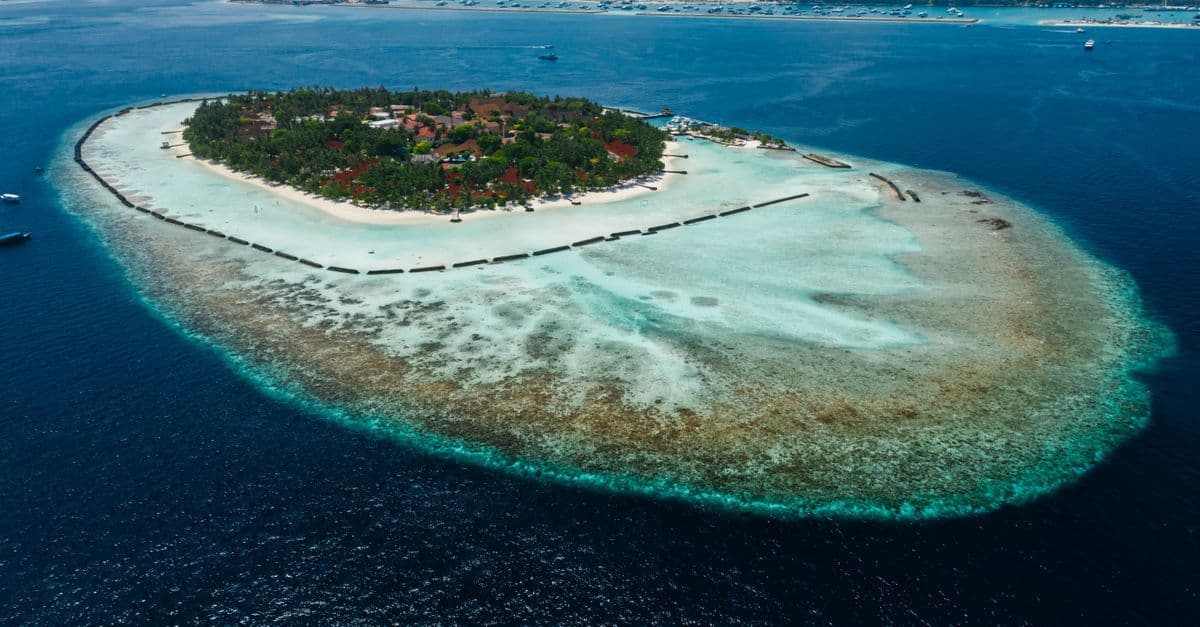
Visit Maldives counts 1,192 islands in 26 atolls, and the Maldives Bureau of Statistics counted 186 inhabited islands at the 2022 census. Some islands are resorts. Guesthouses sit on inhabited islands, where you see daily Maldivian life.
The FCDO sets out how the rules differ:
- Alcohol: only resort islands serve it. Do not take alcohol out of your resort. You can be arrested and deported for having or drinking alcohol, or being drunk, outside resorts and on inhabited islands.
- Dress: outside resorts, including on beaches locals use, cover your shoulders and avoid short or tight shorts. Cover your arms and upper legs when you swim. Nudism and topless sunbathing are banned everywhere, resorts included.
- Religion: the Maldives is an Islamic country, and it is illegal to publicly observe another religion.
- Ramadan: in 2027 it may start on 7 February and last 29 or 30 days. During it, do not eat, drink or smoke in public in the daytime outside holiday resorts.
Families, couples and solo travellers weigh the choice differently
Each group has its own reasons:
- Families with young children: a resort near the airport means a speedboat ride and no seaplane cut-off after the long flight. Trans Maldivian Airways carries children under two free, but with no seat or baggage allowance of their own.
- Couples planning a drink at sunset: a resort island, as only resorts serve alcohol.
- Travellers who want to see local life: a guesthouse on an inhabited island, keeping to the dress and alcohol rules above.
- Solo travellers: either can work. The FCDO's Maldives advice links to its guidance on solo and independent travel and for women travellers.
Comparing Maldives holiday prices like for like
Prices change with the island, the season and what a quote includes. Before you compare, check that each quote covers the same things: flights, the room, meals and drinks (all-inclusive or not), the transfer and taxes.
Visit Maldives says a tourism goods and services tax (T-GST) applies at tourist establishments, and guests also pay a green tax per person per day. Ask whether a quote includes both.
Seaplane luggage over the allowance costs extra, as the packing section explains. The average visitor stayed 7.0 days in 2025, the Bureau of Statistics says, and the month table above shows when demand peaks.
Package or separate bookings: what ATOL changes
ATOL is financial protection, run by the UK Civil Aviation Authority, for package trips that include a flight. If your travel company fails while you are away, ATOL helps you continue your trip and, depending on the circumstances, arranges flights home. It is not travel insurance.
You should get an ATOL Certificate when you pay. A flight bought from an airline or travel company that gives you a valid e-ticket is not ATOL-protected. You cannot claim from ATOL for cancellations, complaints, sickness or injury during your holiday, so take those to your travel provider. The CAA's atol.org pages gave these rules in October 2026. Before you book, read them there and use its Check for ATOL page to confirm the company holds an ATOL.
If you book flights and the resort separately, read your travel insurance closely. The FCDO says cover should include your itinerary, planned activities and expenses in an emergency.
Three, Vodafone and O2 charge extra to roam in the Maldives
Going by their roaming pages in October 2026, three UK networks leave the Maldives out of their usual deals:
- Three lists it under Rest of the World, among the destinations Go Roam does not include.
- Vodafone puts it in Rest of the World on pay monthly plans, outside Euro Roam and Global Roam. You can add an Extra or pay a daily charge.
- O2 leaves it off both its Travel Inclusive Zone and its Inclusive Zone Ultimate.
Check your network's own page for the exact charge. Our guide to using your phone abroad compares UK charges and phone settings.
A local SIM is another option. Visit Maldives says prepaid SIM cards from two mobile providers are on sale at the airport, for calls and data.
If you stay on one resort island and its Wi-Fi reaches your room, you may need little mobile data. Data helps most away from Wi-Fi: at the airport while you wait for a transfer, on the boat, in Malé and on local islands. Estimate how much data you need before you pick a plan.
HelloRoam's Maldives plans connect to Dhiraagu's network. Every plan runs on 4G. A plan only starts when your phone first connects to a network in the Maldives, so you can install it at home before you fly.
First confirm your phone works with eSIM, then install the eSIM before you fly while you are on home Wi-Fi.
Safety points from the FCDO for a Maldives holiday
The FCDO's Maldives advice, last updated on 12 August 2026, notes that no travel can be guaranteed safe. It makes these points for holidaymakers:
- Swimming: strong tidal currents can drag swimmers away from the shore and have caused drownings. Ask resort staff where it is safe, and swim only in supervised or designated areas.
- Boats: there have been fatal propeller accidents in the South Ari Marine Protected Area and at nearby whale shark sites. Take extra care when you swim or snorkel near boats.
- Diving: many resort islands are more than an hour from the nearest of the country's 3 hyperbaric chambers. Ask your dive operator how they would get you to one.
- Crime: crime levels are low on the resort islands, but petty crime does happen. Gang-related violence occurs mainly in Malé and Hulhumalé, so avoid empty roads on foot, particularly after dark.
- Terrorism and protests: attacks cannot be ruled out, including in places foreign visitors go. Political protests take place occasionally in Malé; stay away from them.
- Drugs: penalties are severe, even for small amounts of cannabis, and airports scan transit passengers' bags too.
- LGBT+ travellers: same-sex relations are illegal, and a conviction can mean a fine or a long prison sentence.
- Health: the only fully equipped hospitals are in Malé and Hulhumalé, and many resorts are several hours from emergency treatment. Check that your insurance covers medical evacuation. Dial 102 for an ambulance and 119 for the police.
Read the FCDO's full Maldives travel advice before you go, and sign up for its email alerts so you hear about changes.
Seaplane baggage limits shape what you pack
In October 2026, Trans Maldivian Airways allows 25 kg per person: 20 kg of checked luggage and 5 kg of hand luggage. No bag may weigh over 32 kg, and extra weight costs US$5 per kg plus taxes. Smart bags are accepted only if the battery can be removed.
If your resort uses another transfer, ask for its limits before you pack.
Visit Maldives suggests cotton clothes for the heat and sandals you can slip off. Add cover-ups that meet the dress rules above if you plan to visit a local island.
Leave behind anything customs bans, such as alcohol and pork products. If your medicine contains controlled substances, the FCDO says to carry your doctor's prescription and check Maldivian rules before you fly.
On the way home, the FCDO says it is illegal to take coral or tortoiseshell items out of the Maldives. Our general packing list for a holiday covers the basics.
Questions travellers ask
Is there a cyclone or tsunami risk in the Maldives?
Tropical cyclones rarely cross the Maldives, the Maldives Meteorological Service says. Cyclones forming over the Bay of Bengal, the Arabian Sea and the southern Indian Ocean can still bring heavy rain and strong winds. The National Disaster Management Authority says the country's position near the equator prevents direct effects of cyclones. Local infrastructure is not built for strong winds, though, so indirect effects can still be devastating. The authority rates the cyclone wind hazard higher in the northern atolls. Tsunamis can reach the islands: the 2004 Indian Ocean tsunami hit all but 9 islands, killing 82 people, with 24 more missing and presumed dead. The authority says tsunami risk is particularly high along the eastern atolls. The Met Service posts alerts on its website, so check it before and during your trip and follow official instructions.
Sources
- FCDO Maldives travel advice: entry requirements (updated 12 August 2026)gov.uk
- FCDO Maldives travel advice: safety and securitygov.uk
- FCDO Maldives travel advice: warnings and insurancegov.uk
- FCDO Maldives travel advice: healthgov.uk
- FCDO Maldives travel advice: getting help (emergency numbers)gov.uk
- Maldives Immigration: Tourist Visa On Arrival (updated 10 September 2026)immigration.gov.mv
- Maldives Immigration: IMUGA Traveller Declarationimuga.immigration.gov.mv
- UK Civil Aviation Authority: What is ATOL protection?atol.org
- UK Civil Aviation Authority: What ATOL doesn't coveratol.org
- Virgin Atlantic: Flights to the Maldives (seasonal Heathrow to Malé timetable)virginatlantic.com
- Maldives Meteorological Service: Climate of Maldivesmeteorology.gov.mv
- Maldives Meteorological Service: Awareness (hazards and alert levels)meteorology.gov.mv
- World Weather Information Service: Malé climate (Maldives Meteorological Service, 1981 to 2000)worldweather.wmo.int
- World Weather Information Service: Hanimaadhoo climate (1998 to 2017)worldweather.wmo.int
- World Weather Information Service: Gan, Addu Atoll climate (1981 to 2000)worldweather.wmo.int
- Maldives Bureau of Statistics, Statistical Yearbook 2026, Table 10.2: accommodation establishments, 2019 to 2025statisticsmaldives.gov.mv
- Maldives Bureau of Statistics, Statistical Yearbook 2026, Table 10.3: bed capacity and utilization by monthstatisticsmaldives.gov.mv
- Maldives Bureau of Statistics, Statistical Yearbook 2026, Table 10.9: tourist arrivals by monthstatisticsmaldives.gov.mv
- Maldives Bureau of Statistics, Statistical Yearbook 2026, Table 10.13: arrivals by nationality and month, 2025statisticsmaldives.gov.mv
- Maldives Bureau of Statistics, Statistical Yearbook 2026, Table 3.6: number of inhabited islands, 1985 to 2022statisticsmaldives.gov.mv
- ONS: Consumer price inflation, UK, December 2025ons.gov.uk
- ONS: Consumer price inflation, UK, January 2026ons.gov.uk
- ONS: Consumer price inflation, UK, July 2026ons.gov.uk
- Maldives Manta Conservation Programme: Mantas of the Maldivesmaldivesmantaconservation.org
- Maldives Manta Conservation Programme: Protected areas (Hanifaru Bay)maldivesmantaconservation.org
- UNESCO Man and the Biosphere Programme: Baa Atollunesco.org
- Maldives Whale Shark Research: Researchmaldiveswhalesharkresearch.org
- Visit Maldives: Whale sharks, South Ari Atollvisitmaldives.com
- Visit Maldives: Whale sharks, Baa Atollvisitmaldives.com
- Visit Maldives: Diving in North Malé Atollvisitmaldives.com
- Visit Maldives: Diving in Addu Atollvisitmaldives.com
- Visit Maldives: Surfing in the Maldivesvisitmaldives.com
- Visit Maldives event calendar: Giants of the Maldivian Sea (manta season at Hanifaru Bay)events.visitmaldives.com
- Visit Maldives: Travel Informationvisitmaldives.com
- Visit Maldives: Connectivityvisitmaldives.com
- Visit Maldives: Geographyvisitmaldives.com
- Visit Maldives: Maldivian side of life (inhabited islands)visitmaldives.com
- Visit Maldives: About us (national tourism office)visitmaldives.com
- Trans Maldivian Airways: FAQ (operating hours, baggage, infants, surfboards)transmaldivian.com
- Three: Roaming destinationsthree.co.uk
- Vodafone UK: Global roamingvodafone.co.uk
- O2: Travel Inclusive Zoneo2.co.uk
- O2: Travel Inclusive Zone Ultimateo2.co.uk
- GOV.UK: When do the clocks change?gov.uk
- National Disaster Management Authority: Disaster and hazards informationndma.gov.mv
- National Disaster Management Authority: Tsunami, 26 December 2004ndma.gov.mv
Written by
HelloRoam Team
The HelloRoam Team writes our guides on trip planning, visas and eSIMs. For every new or updated guide, we check each fact at its source. Sources include government, park and weather service pages. We note the date we read each one. A second review then checks every fact against its source before the guide goes live. If we cannot confirm a fact, we leave it out. We link those sources inside the guide, so you can check them.