
Much of arriving in China runs through your phone, from the arrival card QR code to the Alipay or WeChat Pay wallet most shops expect. A HelloRoam China eSIM set up before you leave gets you online as soon as you land.
The Chinese Embassy in the UK announced the waiver on 15 February 2026, and the Foreign Office's China entry requirements say the same. We checked both, with the embassy's visa-free FAQ, on 1 October 2026. China's authorities set and enforce these rules, so read the embassy notice again shortly before you travel.
Each way into China comes with its own stay limit
The 30-day waiver covers most short trips. The other routes matter if you are passing through, working, studying or splitting a trip with Hong Kong or Macao.
 Get your China eSIM before you flyInstall it at home, then switch on data roaming for it when you land. From £2.60.See China plans
| Route | Who it covers | Stay allowed | Do you apply? |
|---|---|---|---|
| 30-day visa waiver | Ordinary passports listing nationality as British citizen, including Crown Dependency passports | Up to 30 days per entry, until 31 December 2026 | No, and no advance declaration |
| 240-hour visa-free transit | UK passports with a confirmed onward ticket to a third country or region | Up to 240 hours (10 days) in permitted areas | No |
| 24-hour direct transit | Any nationality with a confirmed onward ticket, staying inside the port's restricted area | Up to 24 hours | No |
| Visa | Work, study, journalism, long-term assignments or stays over 30 days | Set by the visa | Yes, online, then through the Chinese Visa Application Service Centre |
| Hong Kong SAR | British citizens | Visits of up to 6 months | No visa for visits |
| Macao SAR | British citizens | Up to 6 months for tourism and unpaid business | No visa for these purposes |
The transit rows come from China's National Immigration Administration. The waiver and visa rows draw on the Chinese Embassy in London and GOV.UK's China advice, and the Hong Kong and Macao rows on GOV.UK's advice for each territory.
The 30 days start the day after you arrive
Day one of your 30 is the day after you land, not the day itself, according to the embassy's FAQ on visa-free entry. The count then runs for 30 calendar days. Land in Beijing on 1 November and day one is 2 November, which makes 1 December your 30th day.
You can enter visa-free more than once. The embassy says there is currently no limit on the number of entries or the total days spent in China, provided what you do matches the purpose you entered for. That helps on trips that loop out to Hong Kong, Macao or a neighbouring country and come back.
The waiver also covers sports competitions, conferences, exhibitions and study tours such as summer or winter camps, for stays of up to 30 days. Children follow the same rules as adults. You do not need to tell the embassy before you go, you can arrive from any country, and the waiver applies at any air, sea or land port open to foreign nationals, unless a specific law or agreement says otherwise.
Border officers make the decision on the day. The embassy recommends carrying documents that back up your purpose, such as your return or onward ticket, your accommodation bookings and, for business or family visits, an invitation letter.
No extension past 31 December 2026 has been published
The waiver for UK passports started on 17 February 2026 and ends at midnight Beijing time on 31 December 2026. Neither the embassy's notices nor GOV.UK show a renewal for 2027 yet.
If you are planning a trip for 2027, plan for a visa until the embassy or GOV.UK publishes an extension. The notice also does not say how a stay that starts in late December and runs into January is treated, so if your dates cross the new year, ask the embassy before you book.
A visa is still needed for work, study and longer stays
GOV.UK lists paid work, long-term assignments, journalism and study as reasons that need a visa, along with any stay of more than 30 days. Travellers who arrive without the right visa or visa-free access are refused entry. Plans can change once you arrive. If you have a sound reason to stay past 30 days, the embassy's FAQ says you apply for a stay permit at the local public security exit and entry office.
Work needs a Z visa and a valid work permit, because tourist and business visas do not allow paid work. GOV.UK notes that teachers have been detained and deported for working on the wrong visa.
Some documents fall outside the waiver. Emergency Travel Documents need a visa, and the embassy's FAQ says the same of any travel, temporary or emergency document that is not an ordinary passport. GOV.UK's statement covers passports that list your nationality as British citizen. If yours shows another British nationality, such as British National (Overseas), confirm your position with the embassy before you book.
Chinese-British dual nationals need extra care. China does not recognise dual nationality, and GOV.UK says someone born in China to a Chinese national parent is treated as a Chinese citizen, even when entering on a British passport.
Visa applications from the UK start online
Applications now begin on the China Online Visa Processing System, reached through the Chinese Visa Application Service Centre website. GOV.UK lists centres in London, Manchester, Edinburgh and Belfast. You pay the visa fee and the centre's service fee when you hand in your application, so check what British citizens pay first.
Fingerprints are one detail some travel guides still get wrong. From 17 December 2025 to 31 December 2026, the embassy has waived fingerprinting for short-term visas, meaning stays of up to 180 days. GOV.UK's China page still mentions a fingerprint scan when you apply, but the embassy sets the visa rules, and GOV.UK itself tells travellers to check with it when unsure. Applicants for D, J1, Q1, S1, X1 and Z visas, which lead to a residence permit, still give fingerprints.
GOV.UK asks for more passport validity than the embassy does
The two official sources set different passport rules. The embassy asks for an ordinary passport valid for at least the length of your stay. GOV.UK says your passport must have an expiry date at least 6 months after the day you arrive, plus 2 blank pages for visas and stamps.
Planning around the GOV.UK rule is the safer choice, as it is the stricter of the two, and the Foreign Office suggests checking with your travel provider that your documents meet requirements. A passport that has been reported lost or stolen will be refused at the border.
Transit through China has two separate visa-free schemes
Transit is one of the purposes the 30-day waiver covers. China's National Immigration Administration also runs two transit schemes of its own.
The 240-hour visa-free transit rule covers nationals of 57 countries, the UK among them. You need an ordinary passport and an onward ticket with a confirmed seat and date to a third country or region. You can then stay up to 240 hours, or 10 days, inside the permitted areas, entering through one of 65 ports in 24 provinces, regions and municipalities.
The 24-hour rule is simpler: anyone with a confirmed onward ticket who stays inside the port's restricted area needs no visa. The 240-hour scheme does not cover work, study or news reporting, which still need a visa.
Hong Kong and Macao run their own border controls
Hong Kong and Macao are Special Administrative Regions of China with separate immigration controls. GOV.UK says British citizens can visit either for up to 6 months without a visa. In Macao, that covers tourism and unpaid business.

Coming back into the mainland is where advice gets muddled. Under the 30-day waiver you can enter more than once, and each stay is capped at 30 days. GOV.UK's Macao entry page, last updated on 11 December 2025, before the UK waiver began, still says British passport holders need a Chinese visa before crossing from Macao. The embassy's FAQ is the newer source, but if your route depends on a land crossing, confirm it with the embassy.
Visa holders follow different rules. GOV.UK says that if you visit Hong Kong from the mainland on a visa and want to return, your visa must allow a second entry.
Arrival in mainland China comes down to six steps
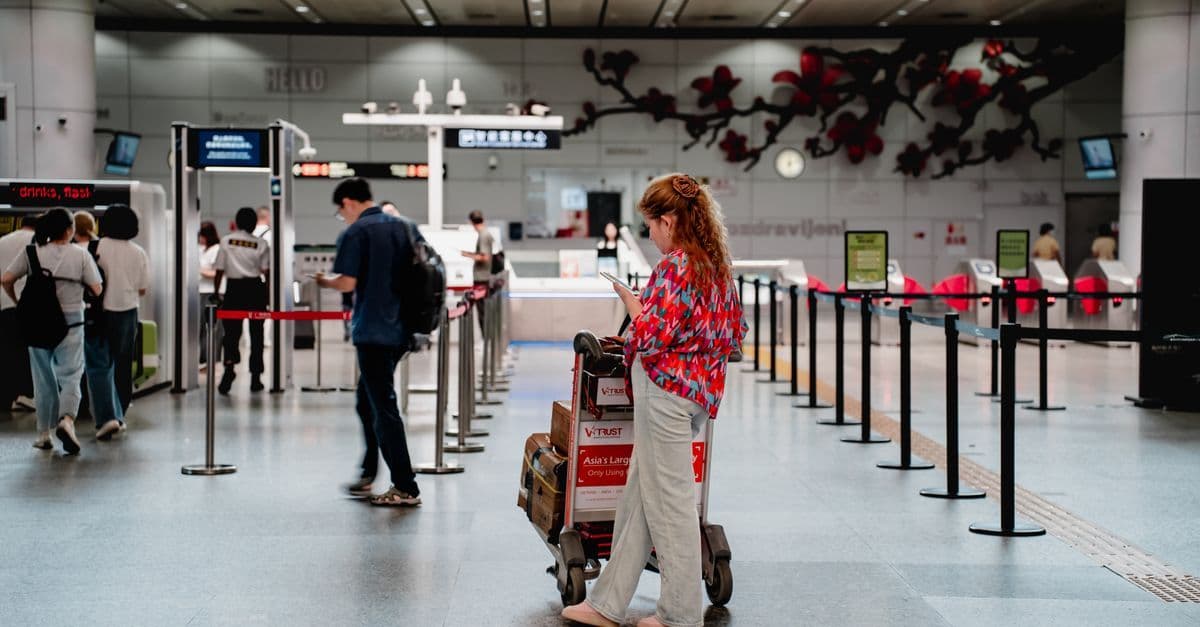
- Submit your arrival card online before you fly, on the National Immigration Administration's arrival card site, its app, or the WeChat or Alipay mini programmes. If you miss it, scan the QR code at the border, use a self-service terminal or fill in a paper card. Travellers using the e-Channel fast lanes, and passengers in direct transit for under 24 hours who stay in the port area, are exempt.
- Be ready for health screening. GOV.UK says this may be a body temperature scan or, more rarely, swabs, blood tests or a medical examination. Not taking part can mean being refused entry.
- At the immigration desk, officers may scan your fingerprints and take a photo, and they check that your trip fits one of the waiver's purposes.
- At customs, declare anything that may be prohibited or subject to tax or duty.
- Register your address within 24 hours. Hotels do this when you check in. If you stay anywhere else, such as with friends, registering with the local Public Security Bureau is your job.
- Carry your passport at all times. Police make random checks and do not accept printed copies, and you need the passport to buy train tickets and to board.
Ignore any website that charges to register you for visa-free entry or to file your arrival card. The embassy says waiver travellers need no advance declaration, and the official arrival card channels are the ones listed above.
Your phone handles payments and paperwork after you land
Mobile wallets run daily spending in mainland China. GOV.UK describes payment through WeChat and Alipay as almost universal, and notes that outside the major cities credit cards are not always accepted. The embassy's payment guide for visitors says Visa and Mastercard cards can be added to Alipay, which you register with your mobile number, so set it up at home before you go.

Some familiar apps will not work. GOV.UK lists Google, Facebook and YouTube as permanently blocked, and those limits apply on our China eSIM plans too. China's cybersecurity laws also say services such as VPNs need a government licence.
HelloRoam's China plans run on China Unicom and China Telecom. Install the eSIM in the UK while you are on Wi-Fi, following our step-by-step eSIM install guide, then switch it on when you land. If you are not sure your handset can take one, check whether your phone supports eSIM first.
A month of maps, ride-hailing and payments adds up, so estimate the data your trip needs before you pick a plan. If your trip also takes in Hong Kong or Macao, a HelloRoam Greater China plan covers all three on one eSIM.
Questions travellers ask
Can I take ibuprofen to China?
No Chinese or UK government page we found names ibuprofen. GOV.UK's China health advice says some medicines bought in the UK may not be allowed into China, and tells you to check with your GP and the Chinese Embassy before you travel. TravelHealthPro advises keeping medicines in their original packaging in your hand luggage.
I live in the UK but don't hold a British passport. Does the waiver cover me?
Your passport decides it, not where you live. The embassy's FAQ lists the countries whose ordinary passport holders can visit mainland China visa-free for up to 30 days. Ireland is on that list, for the same purposes as the UK and until 31 December 2026. Some other nationalities are exempt under separate mutual agreements with China, so check the embassy's pages for your passport.
Sources
- Notice on China's Visa Waiver Policy for the UK and Canada (Chinese Embassy in the UK)gb.china-embassy.gov.cn
- Entry requirements: China travel advice (FCDO, GOV.UK)gov.uk
- FAQs on Visa-free Entry into China (Chinese Embassy in the UK)gb.china-embassy.gov.cn
- Notice on Online Completion of Foreigners' Arrival Card (Chinese Embassy in the UK)gb.china-embassy.gov.cn
- Notice on the Extension of the Exemption from Fingerprint Collection for Chinese Visa Applicants (Chinese Embassy in the UK)gb.china-embassy.gov.cn
- Notice on Launching the China Online Visa Processing System (Chinese Embassy in the UK)gb.china-embassy.gov.cn
- Visa-Free Transit Policies (National Immigration Administration)en.nia.gov.cn
- Online arrival card (National Immigration Administration)s.nia.gov.cn
- Chinese Visa Application Service Centre, Londonvisaforchina.cn
- Entry requirements: Macao travel advice (FCDO, GOV.UK)gov.uk
- Entry requirements: Hong Kong travel advice (FCDO, GOV.UK)gov.uk
- Safety and security: China travel advice (FCDO, GOV.UK)gov.uk
- Health: China travel advice (FCDO, GOV.UK)gov.uk
- Guide to Payment Services in China (Chinese Embassy in the UK)gb.china-embassy.gov.cn
- Medicines and travel (TravelHealthPro, NaTHNaC)travelhealthpro.org.uk
Written by
HelloRoam Team
The HelloRoam Team writes our guides on trip planning, visas and eSIMs. For every new or updated guide, we check each fact at its source. Sources include government, park and weather service pages. We note the date we read each one. A second review then checks every fact against its source before the guide goes live. If we cannot confirm a fact, we leave it out. We link those sources inside the guide, so you can check them.