Top things to do in Tokyo at a glance
Set up an eSIM for Japan from HelloRoam before you fly and maps, train apps and restaurant bookings work from the moment you clear arrivals at Narita or Haneda.
 Get your Japan eSIM before you flyInstall it at home, then switch on data roaming for it when you land. From £2.39.See Japan plans
The five Tokyo experiences worth the flight
Senso-ji: go before the crowds arrive
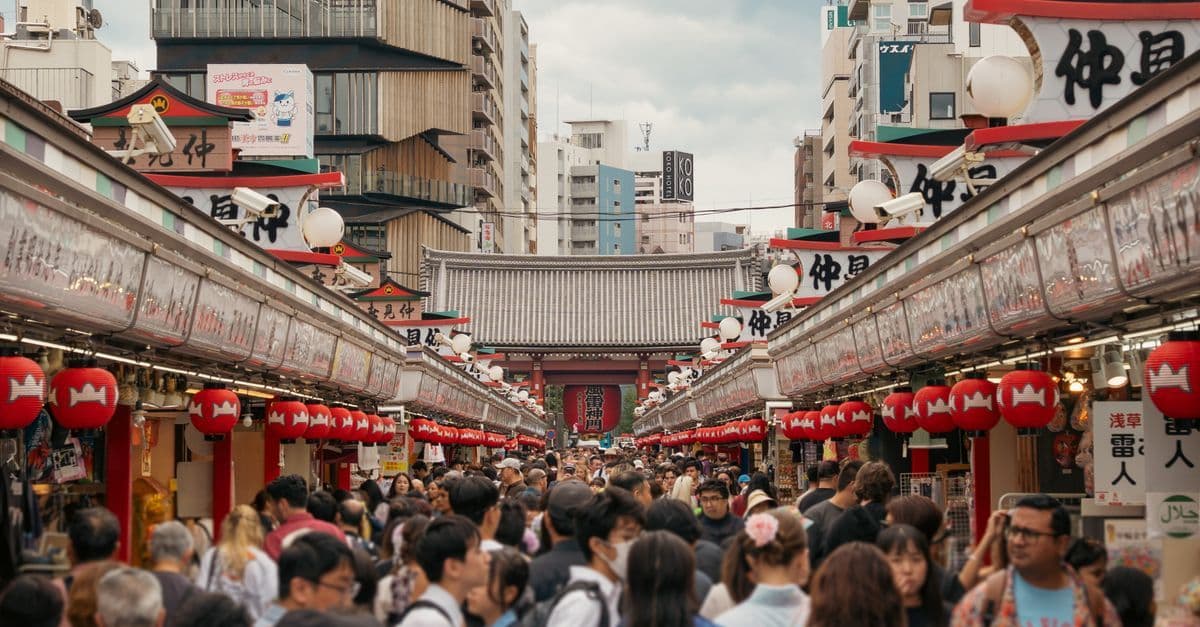
Senso-ji is free to visit, with no booking. The Main Hall opens at 6am (6:30am from October to March) and closes at 5pm, according to the temple. Walk the Nakamise-dori shopping arcade early and you get incense smoke rising in the cool morning air and far fewer people in the frame. By 10am it's a different experience entirely. After dark, the temple lights up its main buildings from sunset until about 11pm every day.
Shibuya Crossing: more than the shot
Upwards of 1,000 people cross at a time, GO TOKYO says, and standing inside it feels like choreography. The Starbucks directly above the crossing gives you the aerial shot that fills every travel feed; across the street, Shibuya Center Gai is home to hundreds of shops, bars and restaurants for the evening that follows, GO TOKYO says. Go to both.
Tsukiji and teamLab Planets
The wholesale fish market moved to Toyosu in 2018, but Tsukiji's outer market stayed open, with around 460 shops and fresh sushi for breakfast. GO TOKYO says it is liveliest between 9am and 1pm, and that the market closes on Wednesdays, Sundays and national holidays, when many shops close too. Bring cash: GO TOKYO says most of the market's stores take cash only.
teamLab Planets sits in Toyosu, a 3-minute walk from Shin-Toyosu Station on the Yurikamome Line or 10 minutes from Toyosu Station on the Tokyo Metro Yurakucho Line. It's a digital art installation that's easier to experience than to describe. teamLab says tickets are not sold on site, so buy yours online before you go.
Shinjuku's yakitori alleys
Memory Lane (Omoide Yokocho) sits by the west exit of Shinjuku Station. Its own site counts about 80 shops, around 60 of them places to eat and drink, mostly serving yakitori and motsu-yaki (grilled offal). Golden Gai, in Kabukicho on the east side of the station, packs in about 290 small bars, its street association says. Read the FCDO's nightlife advice in the safety section below before a night out there.
Where to stay in Tokyo: five neighbourhoods compared
Five districts cover the range for a first stay in Tokyo. Asakusa suits temple-seekers; Shinjuku works for anyone who wants a central base; Shibuya appeals to the fashion-forward crowd; Shimokitazawa draws those actively avoiding tourist circuits; and Ueno fits families and museum-goers well.
| Neighbourhood | Character | Best for |
|---|---|---|
| Asakusa | Ancient temple district, traditional craft shops, low-rise streets | First-timers, culture seekers |
| Shinjuku | Major transport hub, Kabukicho nightlife, Nishi-Shinjuku skyscrapers | All visitor types, solo travellers, late arrivals |
| Shibuya | Fashion, specialty coffee, younger energy | Shoppers, design-minded visitors |
| Shimokitazawa | Vintage clothing, bookshops, music shops, independent cafes | Independent travellers, return visitors |
| Ueno | Museums, Ueno Park, Japan's oldest zoo | Families, culture-focused visitors |
Choosing a base
Asakusa is the practical first choice if Senso-ji and old Tokyo are the draw. The architecture stays low-rise and old-city in feel, and you wake up within walking distance of the temple. The trade-off: GO TOKYO puts Asakusa 35 minutes by train from Shinjuku Station, so factor the trip back into late-night plans.
Shinjuku resolves the transport question. GO TOKYO lists JR lines, the Keio and Odakyu railways, the Tokyo Metro Marunouchi Line and the Toei Shinjuku and Oedo lines at Shinjuku Station, which makes it a practical hub for day trips out of the city too. It's the logical base for anyone whose itinerary spans more than one neighbourhood.
Shimokitazawa and Ueno are niche picks, but the right ones for specific travellers. Shimokitazawa suits visitors who've done Tokyo before and want something quieter: GO TOKYO describes a laid-back district of vintage clothing stores, bookshops, music shops, cafes and bars. Ueno works if museums are central to the trip, or if you're travelling with children: Ueno Park holds many museums and Japan's oldest zoo.
All five neighbourhoods share one practical requirement: you'll need data to get between them. Google Maps can plan routes across Tokyo's trains and subway, but Google says public transport directions are unavailable offline. Sort out mobile data for Tokyo before you board.
Getting mobile data in Tokyo
One thing to sort before boarding: check whether your UK plan covers Japan. On Three Pay Monthly, Japan is a Go Roam destination. Plans with Go Roam built in cover it at no extra cost; on the others you buy a Go Roam pass or pay £7 or £8 a day, depending on when you joined or upgraded. Three Pay As You Go lists Japan outside Go Roam, and O2 includes Japan only on its Ultimate plans. Without cover in place, your UK SIM runs up data roaming charges from the moment you land.
Key fact: A HelloRoam Japan plan counts its days from the first time the eSIM connects in Japan, not from when you buy or install it. Most of our fixed-data Japan plans run on KDDI/au and SoftBank, the largest runs on NTT docomo, and the daily plan uses NTT docomo, Rakuten Mobile, KDDI/au and SoftBank. That is our catalogue as of October 2026, and each plan page shows its current networks.
The options, in order of convenience:
- eSIM before you fly. Scan the QR code on home Wi-Fi and follow your phone's prompts to add it, with no SIM swap and no airport queue. Install it the night before departure and you're connected the moment you clear customs at Narita or Haneda.
- Airport SIM. Narita and Haneda both list SIM card counters or vending machines in all three of their terminals, including a Mobile Center in Haneda's Terminal 3 arrival lobby, according to each airport's website. A physical SIM means taking out your UK SIM, so keep it safe for the flight home.
- Pocket Wi-Fi rental. A single device that connects several phones at once, which works well for groups. The overhead is the return: the unit has to go back to the rental firm at the end of your trip.
- Free Wi-Fi. GO TOKYO says the Narita and Haneda terminals, many train and bus companies and many major sights offer free Wi-Fi, but sign-up rules vary and the service ranges from good to patchy. Adequate for a quick map check, not reliable enough for live navigation between districts.
What the weak yen means for your Tokyo budget
The pound now buys more yen than in most years since 2008, which stretches a British traveller's spending money further in Tokyo.
Where your money goes further
Everyday food is where you notice it first. A bowl of ramen at a standing counter, or a convenience store lunch from 7-Eleven or FamilyMart (onigiri, miso soup, a cold drink), keeps a day's food spending low.
What costs more than you'd expect
Flights from London to Tokyo are the first big cost to pin down. Since 1 July 2026, Japan's International Tourist Tax has been 3,000 yen per departure, up from 1,000 yen. The Japan Tourism Agency says airlines usually add it to the ticket price, and eligible tickets issued on or before 30 June 2026 keep the old rate.
Carry some cash. The FCDO says Japan "is still a predominantly cash-based society" and that you may have difficulty using cards issued outside Japan, though post offices, 7-Eleven stores and JP Post Bank have cash machines that accept some foreign cards during business hours. Cards are common too: Japan's Ministry of Economy, Trade and Industry put the country's cashless payment ratio at 58.0% for 2025.
Premium omakase dinners and ticketed art venues such as teamLab Planets add up quickly on a longer itinerary. Plan for those separately from your everyday spending. You can leave tips out of the sums: GO TOKYO says tipping is not practised in Japan, though some places may add a service charge.
Staying safe in Tokyo as a solo British traveller
The FCDO's Japan travel advice tells British visitors to take the same precautions they would at home and to keep their belongings in sight when travelling. It says Tokyo's entertainment districts carry a higher risk of crime, particularly at night in and around clubs and bars, and that foreign nationals have been targeted for extortion, robbery, assault and sexual assault. It also says smoking is illegal on Tokyo's streets, so smoke only in designated areas.
The FCDO also says you must carry your passport at all times, and that some common medicines are illegal in Japan, including Vicks inhalers and cold and flu remedies containing pseudoephedrine. If you travel with medication, it says to check its status with the Japanese Embassy in the UK.
Trains and nights out: what the FCDO warns about
On commuter trains. The FCDO says female passengers have experienced inappropriate behaviour, including touching and upskirting. Police advise shouting at the perpetrator to attract attention and asking a fellow passenger to call train or station staff.
In nightlife districts. The FCDO says reports of drink spiking and credit card fraud have increased. It says Japanese police name Kabukicho, Roppongi, Shibuya and Ikebukuro as high-risk zones in Tokyo, that most British victims report being targeted in Kabukicho, and that victims describe being approached in English by street touts. Its advice: do not follow touts into bars, do not leave drinks unattended, and see a menu with prices before you enter a bar or restaurant.
Getting around and the summer heat
Tokyo runs 13 subway lines across two operators, Tokyo Metro (9 lines) and Toei (4), and GO TOKYO says the stations and trains carry multilingual signs. Getting the wrong train is still easy on day one. A Suica or PASMO IC card lets you tap in, tap out and change lines without buying tickets. GO TOKYO says the Welcome Suica Mobile app lets you set up and top up a Suica before or after you arrive in Japan, and JR East makes that app for iPhone only.
Summer heat is the second thing to plan for. The Japan Meteorological Agency (JMA) recorded average daily highs of 33.2°C in July 2025 and 34.4°C in August 2025 in Tokyo, and the FCDO says heat stroke and heat-related illnesses pose a significant risk in the summer months. Plan around early-morning temples, air-conditioned middays and evening street food.
The best time to visit Tokyo, season by season
The best time to visit Tokyo depends on what you want from the trip: cherry blossom in late March and early April, autumn leaves from late November, festivals in a hot summer, or dry, sunny winter days.
Cherry blossom (late March to early April): In 2026 the JMA recorded Tokyo's cherry trees flowering on 19 March and in full bloom on 28 March, a few days ahead of the normal dates of 24 and 31 March. Ueno Park and Shinjuku Gyoen are the classic spots, and in Ueno, GO TOKYO says, picnic parties under the petals are commonplace in spring.
Autumn (late November to early December): Rikugien Garden's maples are at their best in late November, according to the Tokyo Metropolitan Park Association, and the garden's 2026 evening viewing of the autumn leaves runs from 25 November to 6 December. The average November high is 16.7°C in JMA's 1991 to 2020 normals, mild weather for walking.
Summer (July to August): Hot and humid. The festival calendar compensates: Sumida River fireworks, Obon celebrations, and neighbourhood matsuri (local street festivals) run across both months.
Winter (December to February): Cold, dry and often bright. January is Tokyo's sunniest month in the same JMA normals, averaging 192.6 hours of sunshine.
Golden Week is not your friend.
It strings together Japan's national holidays from Showa Day on 29 April to Children's Day on 5 May, according to the Cabinet Office's holiday list. If your dates fall in it, book rooms and trains early.
Pick your season and lock the flights. The FCDO says visitors on a full British citizen passport can stay in Japan for tourism for up to 90 days with nothing to apply for before they fly, and that the passport must be valid for the whole stay, with a blank page for the visa stamp. Our guide to who needs a Japan visa from the UK covers the exceptions.
We checked the FCDO advice, the Three and O2 roaming terms and the opening hours in this guide in October 2026. Advice and rules can change, so read the FCDO's Japan travel advice again before you go.
Sources
- Roaming abroad: daily roaming charges and Go Roam built in (Three)three.co.uk
- Go Roam destinations: Japan in Go Roam Around the World Extra (Three)three.co.uk
- O2 Travel Inclusive Zone Ultimate (O2)o2.co.uk
- Subways: Tokyo Metro and Toei lines (GO TOKYO, Tokyo Convention & Visitors Bureau)gotokyo.org
- Tsukiji Outer Market (GO TOKYO, Tokyo Convention & Visitors Bureau)gotokyo.org
- Tokyo monthly weather data, 2025 (Japan Meteorological Agency)data.jma.go.jp
- Cherry blossom flowering dates, 2026 (Japan Meteorological Agency)data.jma.go.jp
- National holidays, 2026 and 2027 (Cabinet Office, Japan)cao.go.jp
- Japan travel advice: Safety and security (FCDO)gov.uk
- Japan travel advice: Entry requirements (FCDO)gov.uk
- Daily spot exchange rates against sterling, 23 October 2026 (Bank of England)bankofengland.co.uk
- Spot exchange rate, Japanese yen into sterling (XUDLJYS), 2008 to 2026 (Bank of England)bankofengland.co.uk
- Main Hall opening hours (Senso-ji)senso-ji.jp
- Evening light-up (Senso-ji)senso-ji.jp
- Sensoji Temple (GO TOKYO, Tokyo Convention & Visitors Bureau)gotokyo.org
- Shibuya Scramble Crossing (GO TOKYO, Tokyo Convention & Visitors Bureau)gotokyo.org
- teamLab Planets TOKYO: hours, access and tickets (teamLab)teamlab.art
- Shinjuku Nishiguchi Omoide Yokochoshinjuku-omoide.com
- About Shinjuku Golden Gai (Shinjuku Sanko shopping street association)goldengai.jp
- Shinjuku (GO TOKYO, Tokyo Convention & Visitors Bureau)gotokyo.org
- Asakusa (GO TOKYO, Tokyo Convention & Visitors Bureau)gotokyo.org
- Shimokitazawa (GO TOKYO, Tokyo Convention & Visitors Bureau)gotokyo.org
- Ueno (GO TOKYO, Tokyo Convention & Visitors Bureau)gotokyo.org
- Download areas and navigate offline in Google Maps (Google Maps Help)support.google.com
- Cellular phone, Wi-Fi rental and SIM card sales locations (Narita International Airport)narita-airport.jp
- Cell phones, Wi-Fi rental and SIM cards (Haneda Airport)tokyo-haneda.com
- Wi-Fi and connectivity (GO TOKYO, Tokyo Convention & Visitors Bureau)gotokyo.org
- IC cards and cheap tickets (GO TOKYO, Tokyo Convention & Visitors Bureau)gotokyo.org
- International Tourist Tax increased to JPY 3,000 from July 1, 2026 (Japan Tourism Agency)mlit.go.jp
- Cashless payment ratio 2025 (Ministry of Economy, Trade and Industry)meti.go.jp
- Rikugien Garden: autumn leaves and 2026 evening viewing (Tokyo Metropolitan Park Association)tokyo-park.or.jp
- Tokyo climate normals 1991 to 2020 (Japan Meteorological Agency)data.jma.go.jp
- Cherry blossom full bloom dates, 2026 (Japan Meteorological Agency)data.jma.go.jp
- Using and exchanging money in Japan: tipping (GO TOKYO, Tokyo Convention & Visitors Bureau)gotokyo.org
- Japan travel advice: Health, medication (FCDO)gov.uk
- Welcome Suica Mobile: only for iPhone (East Japan Railway Company, App Store)apps.apple.com
- Shinjuku Gyoen National Garden: spring cherry blossom exhibition (National Gardens Association)fng.or.jp
Written by
HelloRoam Team
The HelloRoam Team writes our guides on trip planning, visas and eSIMs. For every new or updated guide, we check each fact at its source. Sources include government, park and weather service pages. We note the date we read each one. A second review then checks every fact against its source before the guide goes live. If we cannot confirm a fact, we leave it out. We link those sources inside the guide, so you can check them.