

Quick answer: how to renew your UK passport online
You can renew your UK passport online if you're an adult updating an existing adult passport. Apply through GOV.UK, the only authorised channel. No Post Office queue, no photo booth, no countersignatory.
The fee is £102 in 2026, up from £82.50 in previous years, a rise of roughly 23% that catches many applicants off guard at checkout gov.uk. Pay by debit or credit card during the application. Your photo goes in as a smartphone selfie or digital upload via the GOV.UK checking tool, not a printed strip.
Standard processing runs 3 to 10 weeks gov.uk. HMPO (His Majesty's Passport Office) doesn't guarantee a date within that window, so treat the upper end as your planning baseline for this period.
Two faster options exist. Fast track takes roughly one week with an in-person appointment at a Passport Customer Service Centre. The one-day premium service covers genuine emergencies at select offices, available by appointment only.
The online route applies only to adult renewal. First-time applications, child passports, lost or stolen passports, and name changes all require the paper process.
First: confirm you're eligible to apply online.
How long are UK passport renewals currently taking?
Apply at least 10 weeks before your departure date gov.uk. HMPO frames this as the minimum, not the comfortable buffer. The standard service runs 3 to 10 weeks, and in mid-2026, most applications are tracking toward the longer end of that range.
A large cohort of passports issued in 2015 and 2016 are reaching their 10-year validity limit simultaneously this year, colliding with the usual summer travel demand. Two expiry waves at once. The queue reflects it.
HMPO won't commit to a specific turnaround within the standard window. The application tracker shows stages, not dates. Checking it more frequently doesn't shorten anything.
For summer 2026 trips, the arithmetic is tight. A late-July departure ideally needed a mid-May application. A September trip still has some breathing room, but not enough to be casual about.
Common pitfall: Many EU and Schengen countries require at least 6 months of passport validity from your date of entry, separate from the expiry date printed on the document gov.uk. A passport that's technically current can still be refused at a European border. Check entry requirements before booking flights, not after.
If you're already within 10 weeks of departure, don't wait to see whether the standard service moves quickly. Check fast track appointment availability at the same time you submit. Cancelling an unused appointment is straightforward. Missing your travel window is not.
Two paid alternatives can cut the wait considerably.
UK passport fast track and one-day premium: what they cost
Two paid tiers sit above the standard service. Fast track takes roughly one week and requires an in-person appointment at a Passport Customer Service Centre. The one-day premium delivers a same or next-day result at select offices, again by appointment only. Both carry fees above the standard £102.
HMPO publishes current figures for both services on GOV.UK. Those fees change periodically, so confirm the amount when you book rather than relying on third-party articles that may be out of date.
Appointment slots fill quickly. Fast track availability varies by location and shrinks during summer. If this is your plan, book the slot at the same time you start thinking about it, not as an afterthought.
The choice between the two tiers comes down to how much runway you have:
- More than a week before travel: fast track is the sensible choice, with some margin for variability.
- Less than a week, genuine emergency: the one-day premium is available but carries a higher fee and requires attending a designated office in person.
- A holiday that could have been planned earlier: the standard service was always the right answer.
Passport Customer Service Centres are distributed across the UK but concentrated in major cities. If reaching your nearest involves significant travel, factor that journey into the decision alongside the appointment fee itself.
How to renew your passport online: a step-by-step guide
Go directly to GOV.UK. Do not use a third-party service claiming to process applications on your behalf: they charge inflated fees for no added speed, and the application goes through the same official system regardless.
The process in sequence:
- Sign in using your Government Gateway account or GOV.UK account credentials. If you don't have one, creating it takes a few minutes.
- Confirm your eligibility. The system checks you're renewing an existing adult passport, not applying for the first time or making a change that requires the paper route.
- Enter your personal details exactly as they appear in your current passport. Accuracy matters; errors can stall or invalidate the application.
- Upload your photo using the GOV.UK checking tool. Take a smartphone selfie or upload a digital image. No printed strip, no trip to a chemist.
- No countersignatory required. This is one of the practical advantages of the online route over paper: no need to find a qualifying person to sign off on your photo.
- Pay £102 by debit or credit card to complete the submission.
Your old passport is cancelled digitally on submission. It won't be posted back. If it holds a visa that overlaps with an upcoming trip, or you need it as proof of identity before the new one arrives, sort that before you submit. The cancellation is immediate, and recovery options through HMPO are limited once the process begins.
Processing confirmation arrives by email. The HMPO application tracker updates as the passport moves through stages.
With your new document on the way, it's a sensible moment to sort travel data as well. Before your first trip on the new passport, understanding eSIMs means you won't be hunting for a SIM kiosk on arrival or absorbing a surprise roaming bill from EE, Vodafone, or Three. What Is an eSIM? covers the basics clearly.
Documents needed before you start are listed below.
What documents do I need to renew my UK passport online?

According to gov.uk, your current UK passport is the only document you need to hand for an online renewal. Nothing gets posted: HMPO cancels your old passport digitally once the new one is issued.
That distinction matters. Under the old paper system, your passport left your possession for weeks at a stretch. Online, it stays at home throughout.
Check those visa stamps before you submit
Here's the practical detail many applicants overlook. If your current passport holds unexpired visas (a US B-1/B-2 visitor visa, an Australian multiple-entry, or any visa tied to the physical booklet), photograph every stamped page before you submit. Some embassies will transfer a valid visa to a new passport on request; others won't recognise the cancelled document at all. Know your situation before the application completes.
Your Government Gateway login credentials, a smartphone or camera for the digital photo, and your payment card are the other essentials.
When online renewal doesn't apply
Name changes require the paper process. So do lost or stolen passports, and documents that fall outside the eligibility window for online renewal. GOV.UK flags these cases early in the application and redirects you before you invest time in the wrong route.
For a straightforward adult renewal, the document checklist is refreshingly short. That's the sensible design of a system built around not making you queue.
Online renewal vs paper application: which should you choose?
Online renewal suits every standard adult renewal. Paper is reserved for name changes, lost or stolen passports, child passports, and first-time applicants. The boundary between the two routes is more clearly drawn than most people realise.
Where online wins
The case for the digital route comes down to four concrete advantages:
- No posting your passport. The physical document stays with you throughout. Under the paper system, it sits in transit or at a processing centre for weeks.
- No countersignatory required. Paper applications require finding someone eligible to co-sign: a doctor, solicitor, or teacher with the relevant professional standing. The online route drops this requirement entirely allcleartravel.co.uk.
- Generally faster. Online applications move through the standard queue more quickly than paper equivalents at the same service tier.
- Digital photo. A smartphone selfie replaces the post office photo booth run. The system checks your image against HMPO's technical requirements automatically.
Where paper is the only option
Paper isn't just slower. For several categories, it's the only workable route.
First-time applicants use the paper form. Child passports require it. If your name has changed since your last passport was issued, the online service won't process the application. The same applies to lost or stolen documents. Pick up the relevant form at a Post Office branch, or download it directly via GOV.UK.
For the vast majority of adults renewing an existing passport in their current name, the choice is clear. Online is faster, simpler, and doesn't require leaving the house.
Online it is. Next: what this will cost you.
How much does it cost to renew a British passport online?
Adult online passport renewal costs £102 in 2026, up from £82.50 in previous years gov.uk. What surprises most applicants is that this is the floor, not the ceiling: fast track and premium services sit above that rate, and the gap matters if your travel date is pressing.
What the standard fee covers
The online application includes the digital photo check at no extra charge. HMPO's automated image review is bundled into the fee rather than billed separately. That's a tidy arrangement compared to services that charge piecemeal.
Third-party renewal websites complicate this picture. A number of sites present themselves as official-looking passport portals and charge above the GOV.UK rate. Some look credible; none are authorised. The government portal carries no processing surcharge above the published fee. Going directly to GOV.UK is the only way to pay the correct amount.
Service tiers compared
Fast track and premium both carry fees above the standard rate. HMPO publishes current pricing for all tiers on GOV.UK; verify before booking, as these adjust periodically.
The fee increase catches some families off guard at the planning stage. If several passports need renewing before a summer trip, factor that in early rather than at the last minute.
Renewal done. Now sort the trip that follows.
What to sort before your first trip on a new passport
Before your first trip on a new passport, two things deserve attention: whether your passport meets the entry requirements at your destination, and how you'll handle mobile data without making rushed decisions at an airport kiosk.
Check your passport's validity window first
Post-Brexit, EU and Schengen entry requires your passport to have been issued within the last 10 years, calculated from your arrival date gov.uk. That's a different measure from the expiry date. A passport with months still to run can fail this check if the issue date is more than a decade back. Check the data page, not just the expiry.
The six-month validity rule is the second check. Many countries outside Europe require at least six months of passport validity remaining beyond your return date rac.co.uk. A technically valid passport can still be unusable for certain trips. Check before you book, not at check-in.
Sort your data before you reach the gate
Airport SIM kiosks exist, but they're rarely good value, and activating one under arrivals hall lighting after a long-haul flight isn't the most considered moment for a purchasing decision.
An eSIM (a digital SIM built into your phone, activated by scanning a QR code rather than swapping a physical card) removes that entirely. Set it up at home; your phone picks up the local network when you land.
Dual-SIM use is where this earns its place. Your UK number stays live on one profile while the travel eSIM handles data on the other. Banks send one-time verification codes to your mobile the moment you try to pay abroad. Having that line active matters.
HelloRoam activates before you board and supports dual-SIM use, keeping your UK number live for bank texts while the travel eSIM handles data. For a plain explanation of how the technology works, What Is an eSIM? is a useful starting point.
Common questions on renewal answered below.
Staying connected abroad: eSIM, local SIM, or carrier roaming?
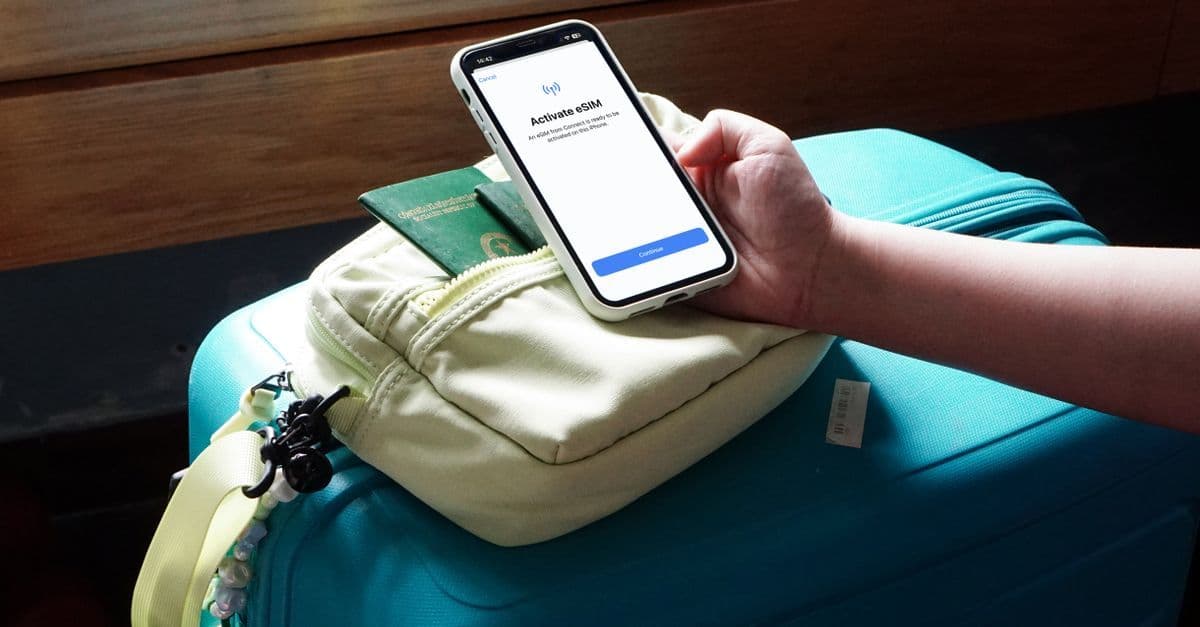
Post-Brexit, UK carrier roaming costs money again across most EU destinations. An eSIM lets you skip that: pre-install at home, connect automatically on landing. A local SIM is often cheaper per gigabyte but requires in-country registration. Carrier roaming is the most convenient option but carries the highest ongoing cost.
The choice comes down to trip length and tolerance for faff.
For a two-night city break staying largely on hotel Wi-Fi, your existing carrier's day-pass arrangement is workable. The fair-use cap buried in the small print is less relevant when you're barely on mobile data. Counter-intuitive, but it holds.
Stretch that to ten days across multiple countries and the maths shifts. Day-pass charges stack up fast, and juggling a local SIM per country means a kiosk queue in every airport arrivals hall.
An eSIM sidesteps both problems.
Scan a QR code the evening before you fly. The profile installs in under two minutes, sits dormant on your phone, and activates the moment you land. Budget per-gigabyte plans cover a short city break without overspending. Tethering-ready options with larger allowances make more sense for longer trips or anyone running a laptop and phone off a single data connection.
Reviewed by HelloRoam's editorial team. Last updated: 10 June 2026.
Get Connected Before You Go


Frequently Asked Questions
Your current UK passport is the only document required. HMPO cancels it digitally once the new one is issued, so it stays with you throughout the process.
Standard processing takes 3 to 10 weeks in 2026, with most applications tracking toward the longer end due to high demand. Apply at least 10 weeks before your departure date.
The easiest method is the online route via GOV.UK, which requires no queuing, no countersignatory, and no printed photos. You upload a digital selfie and pay £102 by card.
Online adult passport renewal costs £102 in 2026, up from £82.50 previously. Fast track and premium services cost more. Always apply via GOV.UK to avoid paying inflated third-party fees.
No. Name changes require the paper application process. The online route is only available for adults renewing an existing passport in their current name.
Fast track takes roughly one week via a Passport Customer Service Centre appointment. The one-day premium handles genuine emergencies at select offices, both priced above the £102 standard rate.
No. Your old passport is cancelled digitally on submission and will not be posted back. If it contains unexpired visas you still need, photograph every stamped page before submitting.
No. The online renewal route does not require a countersignatory. This is one of its key advantages over the paper process, which requires a qualifying professional to co-sign your photo.
You take a smartphone selfie or upload a digital image using the GOV.UK photo checking tool. No printed photo strip or trip to a chemist is required. The system checks it automatically.
Many EU and Schengen countries require at least 6 months of passport validity from your entry date, separate from the printed expiry. Check entry requirements before booking, not at the airport.
No authorised third-party renewal services exist. These sites charge inflated fees but route applications through the same official system. Apply directly via GOV.UK to pay the correct £102 fee.
EU and Schengen entry requires your passport to have been issued within the last 10 years from your arrival date. Check the issue date on your data page, not just the expiry date printed on it.
No. Child passport applications require the paper process. The online renewal route is available only for adults updating an existing adult passport in their current name.
Lost or stolen passports cannot be renewed online. You must use the paper application process. Pick up the relevant form at a Post Office or download it directly via GOV.UK.
An eSIM lets you activate a travel data plan from home before departure. Your UK number stays live for bank verification texts while the travel eSIM handles data, avoiding costly airport SIM kiosks.
Sources
- Renew or replace your adult passport — gov.uk
- How to renew your passport – our step-by-step guide — rac.co.uk
- U.S. Passports — travel.state.gov
- Apply online for a UK passport — gov.uk
- How to renew a UK passport – everything you need to know — allcleartravel.co.uk