



A credible eSIM review discloses five things without making you hunt for them:
- Named carrier partners in your destination, not just a country count
- Per-gigabyte pricing across entry, mid, and premium plan tiers
- Activation method: instant QR delivery or delayed email
- Fair-use throttle thresholds stated in gigabytes, not vague marketing language
- Tethering policy: whether hotspot sharing counts against the main data cap
That last point is where most reviews go quiet.
"Generous data" isn't a disclosure. A review that can't tell you whether hotspot sharing depletes your data pool at the same rate as regular browsing isn't giving you enough to make a real decision.
Validity windows across the current market run from 7 to 30 days. Short-trip plans often expire at local midnight rather than 24 hours after activation. A delayed flight that adds one extra night can leave you without data on the final day.
Named carrier partners are the clearest signal of review quality. A write-up that can't tell you which network your phone attaches to in Frankfurt or Osaka isn't a review. It's a product page with a byline.
But what exactly is a travel eSIM?
Key Takeaways - A credible eSIM review names the specific carrier, not just the destination country. - Fair-use throttle thresholds and tethering policy are non-negotiable disclosures in any honest review. - Carrier unlock (distinct from iCloud or factory unlock) is required before any travel eSIM installs. - Validity windows run 7 to 30 days; expiry logic varies between local midnight and hours-after-activation. - Airport activation before departure eliminates kiosk queues and captive portal problems on arrival.
What Is a Travel eSIM?

A travel eSIM (an embedded SIM profile that installs without a physical card) lives on a chip already inside your phone. No plastic to swap. No SIM ejector tool lost in a hotel drawer somewhere.
Activation runs through a QR code. The provider delivers it after purchase, usually by email, and you scan it in your phone's settings. The carrier profile installs in roughly two minutes. Scan it during boarding, and the profile is active before the wheels come down.
Compatible hardware starts with iPhone XS. Every iPhone Apple has shipped since 2018 supports eSIM natively, and every iPhone 14 and later model sold in the US is eSIM-only. Android support is broader than most travelers expect: Pixel 2 onward, Samsung Galaxy flagships from 2019, and most Android flagships released in the past few years. The actual list of compatible devices is longer than most buyer's guides acknowledge.
Here's the distinction that trips people up at the last minute: carrier unlock is not the same as an iCloud unlock or a factory reset. A carrier-locked iPhone won't install a third-party eSIM profile regardless of what else has been cleared on the device. Check unlock status with your carrier before the trip. Not at the gate.
The dual-SIM setup solves a real practical problem. Your home SIM keeps calls and texts running while the travel eSIM handles data abroad. Banking verification codes, two-factor authentication prompts, and messages from home all arrive normally. Both lines run simultaneously on one device.
AT&T, T-Mobile, and Verizon all offer international day passes and roaming add-ons. For a short weekend in Toronto or Cancun, your existing carrier plan may handle roaming without a major penalty. Stretch the trip to two weeks across multiple countries in Europe or Southeast Asia, and an independent travel eSIM typically costs far less than stacking daily roaming passes.
So what should a trustworthy eSIM review actually measure?
What the Best eSIM Reviews Actually Measure
Five criteria separate a useful eSIM review from a features list. Most published write-ups address two or three. A review worth reading covers all five.
Coverage footprint with named carriers is the starting point. Country count means less than network quality within each destination. A plan claiming access to 150 countries but running on the weakest local MVNO (a reseller that rides another carrier's network without priority traffic access) will drop signal on rural roads before a stronger plan on a tier-1 operator would. The review should name the network your phone attaches to in your specific destination, not just confirm the country appears on a list somewhere.
Data cap structure is the second pillar. Plans branded "unlimited" almost always include a fair-use threshold where speeds step down sharply. A plan with 10 GB at full LTE speed that throttles to 128 kbps afterward functions as a capped plan regardless of the marketing language. Transparent reviews state the threshold in gigabytes.
Activation timing divides the field sharply. Instant QR delivery means you can install the profile from the departure lounge. Some providers push QR codes hours after purchase, which creates real problems for early-morning flights or last-minute bookings. A review should state delivery time explicitly, not just confirm that a QR code exists.
Does support actually respond at 2 a.m.?
That's the criterion most desk-based reviews skip entirely. Checking whether a chat widget loads on a website is easy. Travel tests whether the support team responds outside business hours, when you're nine time zones ahead of headquarters and need a replacement QR code fast.
Per-gigabyte cost benchmarked across plan tiers gives the clearest pricing picture:
Reviews that list only the headline price without breaking out cost-per-GB across tiers don't give you enough to compare plans accurately.
Real travel surfaces gaps that desk-based eSIM reviews miss entirely.
Staying Connected Abroad: What eSIM Reviews Skip
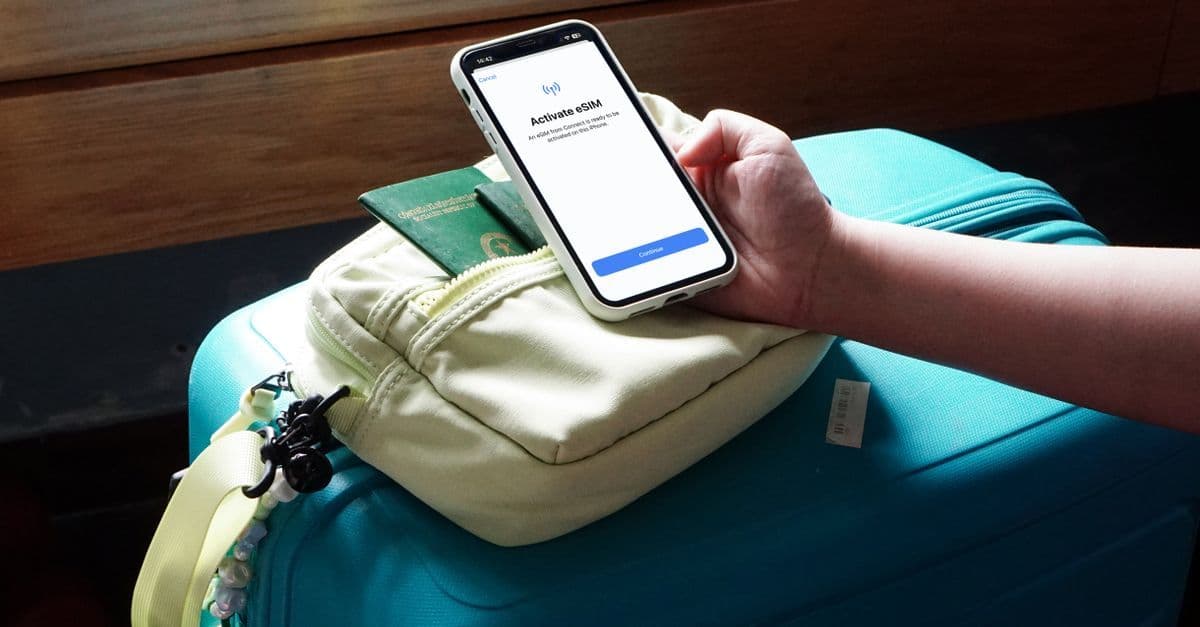
Published eSIM reviews miss four real-world variables: airport activation logistics, hotel Wi-Fi reliability, rural and transit coverage behavior, and hotspot data consumption rates. Desk tests don't catch them. Actual travel does, usually on day one.
Here's the scenario most reviews never simulate: you've cleared customs via Global Entry in under five minutes and your phone still shows your home carrier's roaming connection. The eSIM profile needs activation. The airport Wi-Fi captive portal won't load. The kiosk has 15 people ahead of you.
Activating before departure solves this entirely. Most eSIM profiles install on home Wi-Fi and switch automatically to the destination carrier network on arrival. You land with data running before your luggage reaches the carousel.
Hotel Wi-Fi is a backup, not a primary connection.
Large shared networks across hundreds of rooms degrade reliably during peak evening hours. Relying on hotel Wi-Fi for video calls or anything time-sensitive is a gamble most frequent travelers stop taking after the first failed call. Cellular backup is standard kit, not a luxury upgrade.
Rural and transit coverage gets minimal attention in published reviews. Driving through the Scottish Highlands, riding an overnight bus from Lisbon to Porto, or hiking outside Queenstown puts you on stretches where the carrier listed in the plan spec sheet may not reach. Coverage maps reflect optimal conditions, not road or rail reality.
Hotspot sharing burns through data faster than most travelers budget. Running a phone and a laptop off a shared 5 GB pool across two days of light work is a realistic scenario that exhausts most entry-tier plans well before the trip ends. Any review that skips real-world tethering consumption isn't giving you the full picture.
HelloRoam covers 190-plus destinations and supports coverage on tier-1 carrier networks across its key markets. For US travelers planning multi-country itineraries through Europe or Asia, that destination breadth is worth verifying before you book flights.(https://www.helloroam.com/all-esim) to check coverage by destination.
Compare eSIM plans for your destination — See 2026 pricing →
Coverage claims deserve far closer scrutiny than most reviews give them.
How Coverage Claims in eSIM Reviews Mislead Travelers
eSIM compatibility depends on two factors: device model and carrier lock status.
iPhone XS and later support eSIM natively when carrier-unlocked. US-market iPhones sold since 2022 ship without a physical SIM tray, so eSIM is the only option on those devices. Android is less uniform: flagship models from Samsung, Google Pixel, and OnePlus generally include eSIM hardware, but budget handsets and carrier-branded variants often do not. Check the manufacturer's specifications before purchasing any plan.
Carrier-locked phones require an unlock before any third-party eSIM activates. Most US carriers process unlock requests once the device's installment plan or service contract clears; contact your carrier directly to confirm status before you travel.
Once your device is confirmed as unlocked and eSIM-ready,(https://www.helloroam.com/all-esim) to compare options by destination.
Comparing eSIM Plan Types: Capped, Unlimited, and Daily
Four eSIM structures cover almost every plan you'll encounter in a prod review: fixed-data, unlimited with fair-use caps, daily-rate, and regional bundles. Each charges at a different point and throttles at a different trigger. The wrong structure for your trip doesn't just waste money. It can leave you navigating blind.
Picture map tiles refusing to load at a foreign train station while your "unlimited" connection crawls below useful speed. That fair-use cap was in the terms. Nobody put it on the homepage.
Fixed-Data Plans and Validity Windows
Fixed-data plans deliver clear cost control. Buy an allowance, use it, and speeds drop or service stops until you top up. A 7-day plan covers a long weekend or a short conference trip. A 30-day plan works for extended travel, though it bills across calendar days, including nights spent entirely on hotel Wi-Fi.
Unlimited, Daily, and Regional Plans
"Unlimited" rarely means what it implies. Budget plans commonly throttle after 1 GB of use; premium tiers allow more data before the fair-use cap kicks in. Past either threshold, speeds drop enough to make map loading genuinely unreliable, not merely sluggish.
Daily plans charge per day you activate data, not per gigabyte consumed. Miss a day at a resort on solid Wi-Fi and you pay nothing. On a two-week itinerary with heavy daily use, per-day billing can outrun a fixed regional bundle, so the comparison is worth running before you buy.
Regional bundles charge one flat rate across multiple destinations. Per-gigabyte cost typically runs higher than single-country plans, but for multi-stop itineraries the consolidated billing usually justifies the premium.
A plan's structure tells you how you'll be charged. Whether those speeds hold up when the network is congested is a different question entirely.
FAQ: Your eSIM Review Questions Answered

These questions come up at every stage of the buying process. Device compatibility, top-up access, and tethering policy are the three most common stumbling blocks any solid prod review should address.
Does My Phone Need to Be Unlocked?
Yes, and your OS version matters too. A carrier-locked phone won't accept a third-party eSIM profile regardless of how good the plan looks. Unlocked iPhone XS and later, and select Android devices, support eSIM natively. Before purchasing, open Settings > About and look for an EID number. No EID means no eSIM support at the hardware level. An outdated OS can block activation on an otherwise compatible device, so update before you travel.
Can I Add More Data Mid-Trip?
Top-up availability varies sharply across providers, and not all plans offer it. Some let you buy an additional data block through the app in under two minutes. Others require purchasing a completely new eSIM profile from scratch. Picture yourself at Bangkok's Suvarnabhumi Airport: data hits zero, you open the provider's app, and the only option is a "contact support" button. Verify the top-up process before you buy, not from a departure gate with boarding already underway.
Is an eSIM Worth It for a Trip Under Three Days?
Often no. A short stay with reliable hotel Wi-Fi and a fixed itinerary rarely justifies the research and setup time. The three-day mark is where the calculation tips: once you're navigating transit, switching neighborhoods, and relying on maps away from the hotel network, cellular data earns its place. For a 48-hour city stop with a known hotel connection, skipping the eSIM is a reasonable call.
Do Budget Plans Work for Single-Destination Trips?
Budget plans suit light data users heading to one destination. Per-gigabyte pricing keeps costs predictable when you're not streaming or running background sync. The limitation surfaces once throttling kicks in on longer stays. If usage stays around navigation, messaging, and searches, a capped budget plan is a practical fit.
Does My Plan Support Hotspot Use?
Tethering policy isn't standardized. Some plans block hotspot entirely. Others allow it but count shared data against your cap at an accelerated rate, so a generous allowance disappears fast once a second device connects. Read the policy in the plan terms before committing.(https://www.helloroam.com/all-esim) to verify tethering rules, top-up options, and device compatibility in one place before booking.
Do eSIM reviews apply to my iPhone or Android?
eSIM reviews apply to your device only if your phone is both eSIM-capable and carrier-unlocked. Most travelers assume a recent handset automatically qualifies. That assumption breaks on Android.
Every iPhone from the XS onward supports eSIM, but only when carrier-unlocked. Phones bought directly from carriers often ship locked. A locked device blocks all eSIM activation regardless of how good the plan is.
Android is messier.
eSIM support varies by manufacturer, model, and regional variant. A Galaxy S25 sold in the US carries eSIM; the same model sold in some Asian markets ships without it. Check your specific device specs before buying any plan.
Any prod review you read may cover a provider with flawless activation. None of that matters if your handset fails the compatibility check first.
What happens if I run out of data mid-trip?
Running out of data mid-trip doesn't have to mean going dark. Most plans handle exhaustion one of three ways:
- Top-up: Buy additional data within the same plan. Not every provider offers this, so confirm before you commit.
- Second eSIM: Purchase a fresh plan and install it alongside your current one. As noted above, dual-SIM support on modern phones makes this a workable fallback, not a last resort.
- Throttle, don't cut: Some plans drop to 64 Kbps rather than disconnecting entirely. Enough for text messages and basic navigation.
A thorough prod review flags which recovery options apply.
Most skip it entirely.
Are budget eSIM plans worth it for short trips?
Budget eSIM plans make sense for some trips and not others. The decision comes down to three variables: trip length, data habits, and whether you need to share a connection.
Under three days? Hotel WiFi plus offline maps may cover everything you need. Ride-shares, translation, and messaging apps all function on cached data or short WiFi bursts. Skipping cellular entirely is a legitimate call for a short overnight.
Longer trip, light data user, single destination? A budget plan earns its price. Per-gigabyte pricing rewards restraint.
Bringing a laptop or tablet? Check tethering terms first. Entry-level plans often block hotspot outright or impose a separate cap on shared data. Confirm before you buy.

Reviewed by HelloRoam's editorial team. Last updated: 22 June 2026.
Get Connected Before You Go





Frequently Asked Questions
A travel eSIM is an embedded SIM profile that installs on your phone without a physical card. After purchase, you scan a QR code in your phone's settings and the carrier profile activates in about two minutes.
iPhone XS and later support eSIM natively when carrier-unlocked. Android support includes Pixel 2 and later, Samsung Galaxy flagships from 2019, and most Android flagships released in recent years.
Yes. A carrier-locked phone will not accept a third-party eSIM profile regardless of the plan. Contact your carrier to confirm unlock status before you travel, not at the departure gate.
Open Settings and look for an EID number under About or General. If no EID appears, the device lacks eSIM hardware. An outdated OS can also block activation, so update your phone before traveling.
Activate on home Wi-Fi before departure. Most profiles switch automatically to the destination carrier on arrival, so you land with data already running before your luggage reaches the carousel.
A credible review names specific carrier partners at your destination, states fair-use throttle thresholds in gigabytes, discloses activation delivery times, and clarifies the tethering policy explicitly.
It is the amount of high-speed data you get before speeds drop sharply. Plans marketed as unlimited often throttle to 128 kbps after a set gigabyte limit, making map loading unreliable regardless of the marketing language.
Tethering policy varies by plan. Some plans block hotspot entirely; others allow it but count shared data against your main cap. Hotspot use drains data faster than regular browsing, so confirm policy before buying.
Validity windows typically run 7 to 30 days. Expiry logic varies: some plans expire at local midnight rather than 24 hours after activation, so a delayed flight can cost you data on the final day.
Yes. A dual-SIM setup lets your home SIM handle calls and texts while the travel eSIM manages data. Banking codes, two-factor authentication prompts, and messages from home all arrive normally on both lines.
Often not. A short stay with reliable hotel Wi-Fi rarely justifies the setup. The value tips at three days or more, once you are navigating transit and maps away from a known hotel network.
Top-up availability varies by provider. Some let you buy an additional data block through the app in minutes; others require purchasing a completely new eSIM profile. Verify the top-up process before you buy.
Fixed-data plans give a set gigabyte allowance with predictable costs. Unlimited plans charge a flat fee but throttle speeds after a fair-use threshold that varies by tier and is rarely displayed prominently at purchase.
A regional bundle charges one flat rate covering multiple countries, ideal for multi-stop itineraries. Per-gigabyte cost is typically higher than single-country plans, but consolidated billing usually justifies the premium.
For a short trip to a nearby destination, your carrier's international day pass may be sufficient. For two-week trips across multiple countries in Europe or Asia, an independent travel eSIM typically costs significantly less.
Unlimited travel eSIM plans almost always include a fair-use cap where speeds drop sharply. Budget plans may throttle after 1 GB; premium tiers allow more before the speed reduction kicks in.
It depends on the provider's carrier partners at your specific destination. Quality reviews name the actual network your phone attaches to. An MVNO with lower traffic priority may drop signal where a tier-1 carrier holds.
Daily plans charge per day you activate data, not per gigabyte consumed. If you spend a day on solid hotel Wi-Fi, you pay nothing. On heavy two-week itineraries, per-day billing can exceed the cost of a fixed regional bundle.